




Canggu has evolved beyond a singular narrative into a sophisticated, multi-layered investment landscape. It is no longer enough to simply buy into a popular district; success in 2026 requires a surgical understanding of micro-market dynamics. Performance is now dictated by how effectively a property aligns with specific guest behaviors, localized lifestyle triggers, and the persistent magnetism of the coast.
In this environment, convenience serves as the primary currency. While Bali is marketed as a beach destination, Canggu, in truth, operates as a "proximity destination" Guests aren't merely paying for the existence of the ocean; they are paying for the luxury of scooter-independence. The ability to walk to breakfast, the beach, or a world-class café, bypassing the island’s notorious traffic, is a tangible product feature that justifies premium pricing. A villa that is "scooter-optional" is inherently easier to market, price, and remember, anchoring its value in everyday functional luxury.
However, this coastal advantage brings significant pressure. The beachfront core is not "easy mode." It is an arena of high-density competition and elevated guest expectations. In these prime strips, every acquisition must be judged with extreme precision. Investors are not just buying into a trend; they are entering a commercially competitive hospitality ecosystem where product quality and location clarity are the only true shields against supply growth. To thrive here, one must look past the hype and focus on the technical fundamentals of yield and resale liquidity. In 2026, the smart play isn't just about being in Canggu, it’s about owning the parts of Canggu that the market simply cannot do without.
Reading the Market in Broader Canggu Area
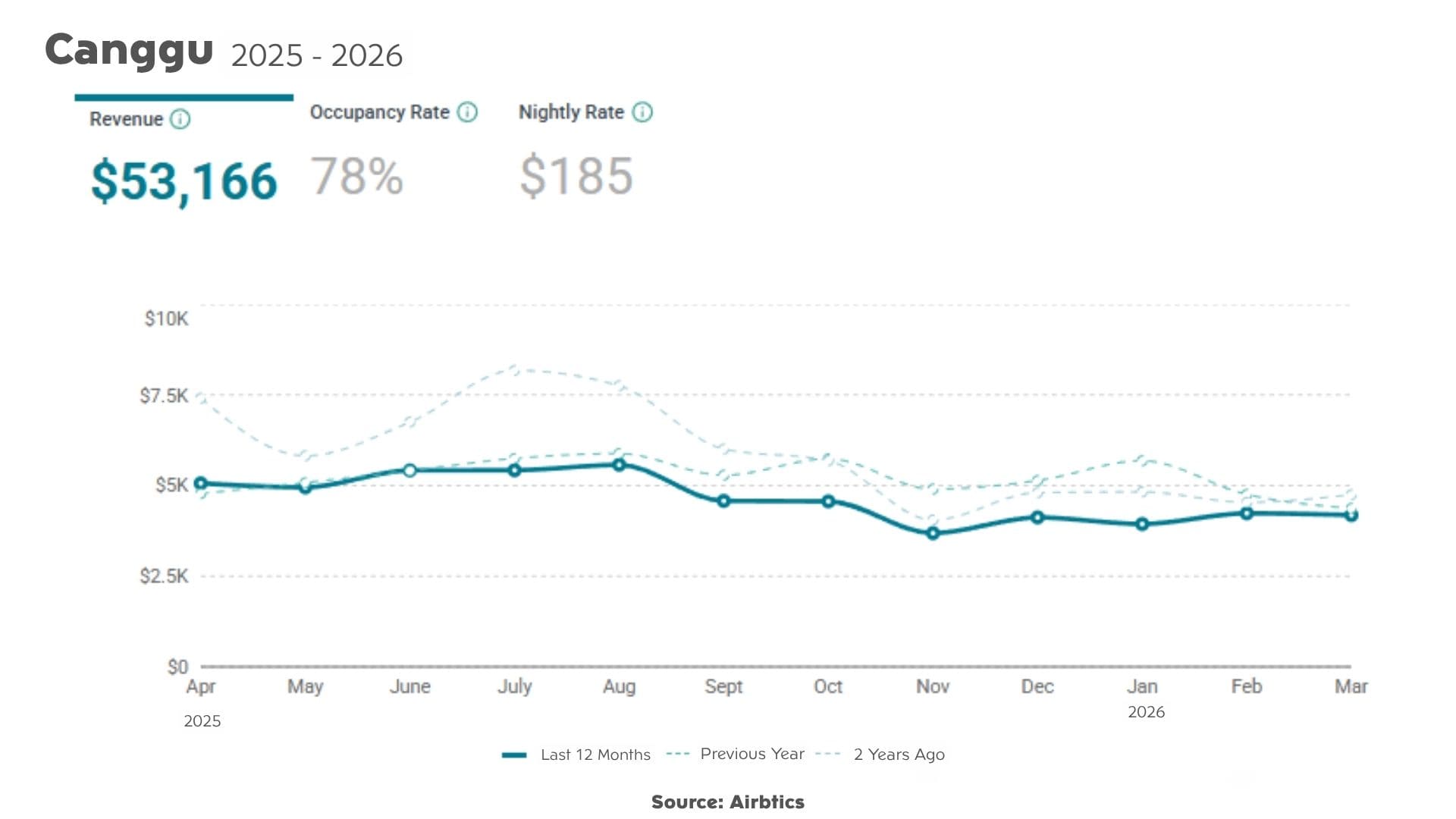
This data above shows the broader Canggu numbers, and just by the glance, it explains why the area continues to attract so much investor attention. Based on the data above, Canggu as a whole is generating $53,388 or IDR 920.000.000 in annual revenue, with 78% occupancy, and $186 or IDR 3.200.000 nightly rate. That is already a very strong baseline. It tells us that Canggu is not just popular in a vague lifestyle sense. It is performing at a level where short-term rental activity is commercially significant, even with a large amount of visible inventory.
Once that baseline is established, the two key core submarkets become much more revealing.
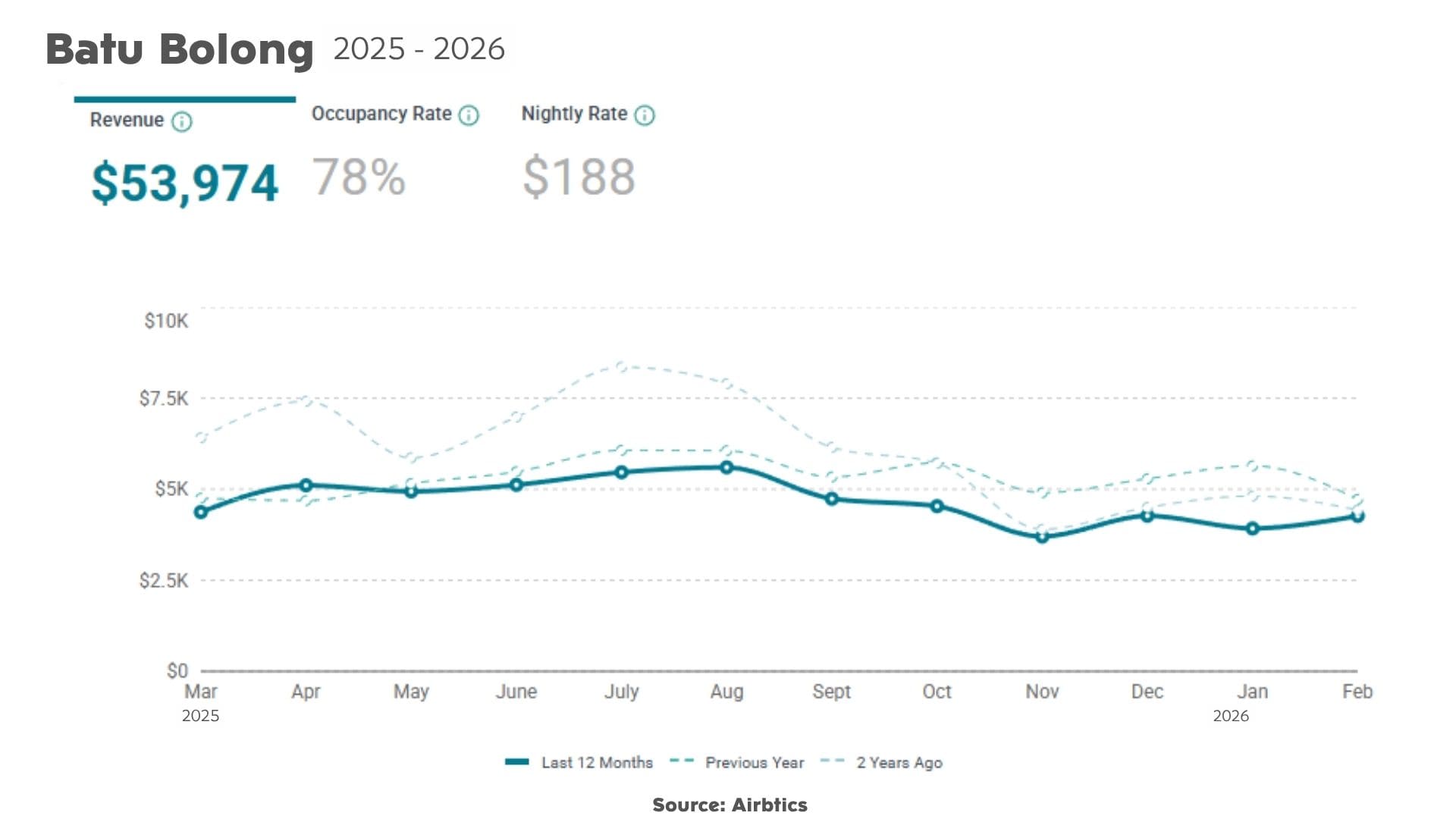
Batu Bolong is showing approximately $53,974 or IDR 930.000.000 in annual revenue from March 2025-January 2026, 78% occupancy, and $188 or IDR 3.237.000 nightly rate. That matters because Batu Bolong is outperforming the broader Canggu average on both revenue and ADR while matching it on occupancy. In practical terms, that means Batu Bolong is not simply full. It is monetizing its demand more efficiently. It is taking broadly similar occupancy and turning it into stronger revenue through higher nightly pricing.
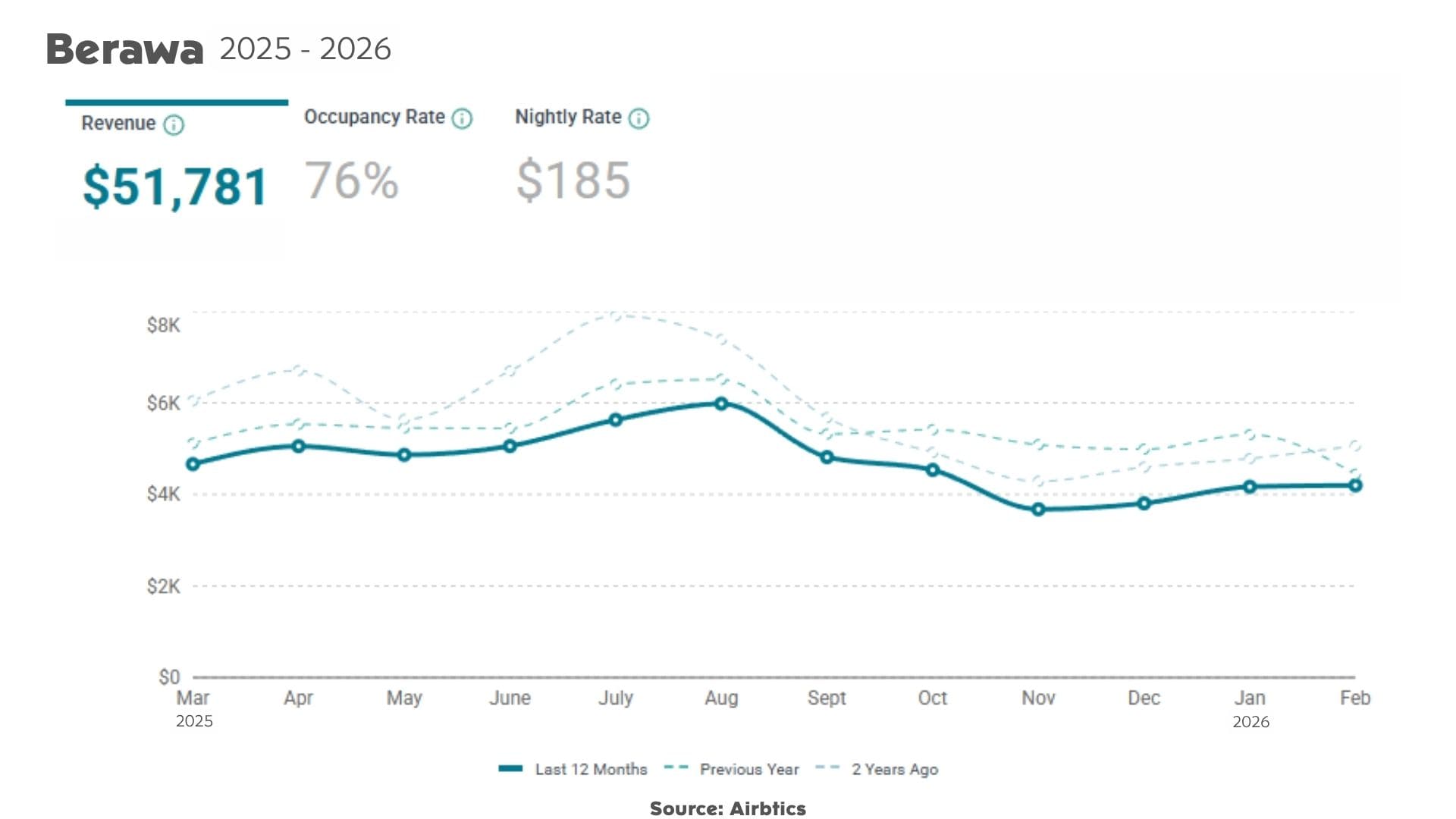
Berawa shows $51,781 or IDR 892.000.000 in annual revenue, 76% occupancy, and $185 or IDR 3.200.000 nightly rate. Berawa’s profile is different, but no less interesting. Revenue stays almost exactly in line with the wider Canggu benchmark, while the nightly rate remains stronger than the whole-area average. Occupancy is slightly lower than Batu Bolong’s, but not by enough to weaken the commercial story. Instead, it suggests Berawa supports a premium position without needing to behave like the most intense turnover market in the district.
This comparison is important because it shows that the beachfront core is not one uniform commercial zone. It contains different ways to excel. Batu Bolong and Berawa are both highly relevant, but they are not interchangeable. One monetizes speed and visibility. The other monetizes stability and premium identity.
If Batu Bolong is the high-velocity yield play, Berawa is the premium anchor.
Batu Bolong
This area benefits from brand recognition that is difficult to overstate. It sits at the center of the short-stay imagination for a large share of Canggu’s visitor market. Guests know what Batu Bolong means before they arrive: surf access, coffee, foot traffic, nightlife-adjacent dining, and a compressed version of the Canggu experience where most things feel close together. That concentration of identity helps explain why it can support $53,974 or IDR 929.000.000 in annual revenue and a $188 or IDR 3.240.000 ADR while competing within the same ecosystem.
That is what makes Batu Bolong a velocity market. It attracts fast bookings, short stays, and a guest profile that wants to be in the middle of the action. This does not make it simple. In fact, the density of listings means investors have to be even more precise. But it does mean the area has proven commercial energy. It remains one of the clearest places in Bali where location alone can immediately communicate value to a traveler.
Berawa
This area works differently, it simply is more anchored. With $51,781 or IDR 892.000.000 in annual revenue, 76% occupancy, and a $185 or IDR 3.200.000 ADR, Berawa looks like a market that holds premium ground without relying on exactly the same guest psychology. It attracts travelers who often want a slightly more polished or stable environment, one that still connects to Canggu’s lifestyle economy but can feel less compressed than Batu Bolong.
That makes Berawa especially attractive to guests who value premium fitness culture, proximity to established hospitality infrastructure, and a more balanced version of the Canggu stay. It is easy to understand why this would support a strong revenue floor. Berawa does not need to win through sheer pace alone. It can win through consistency, profile, and a guest mix willing to pay for a more refined core location.
For investors, the lesson is clear: Batu Bolong is the more obvious high-turnover play, while Berawa is the more stable premium asset play. Both work, but they do so for different reasons.

What the Numbers Say About Competition and Occupancy
One of the most useful ways to understand Canggu is through occupant efficiency. Occupancy alone does not tell the full story. What matters just as much is how well the market continues to absorb bookings even when supply is already high.
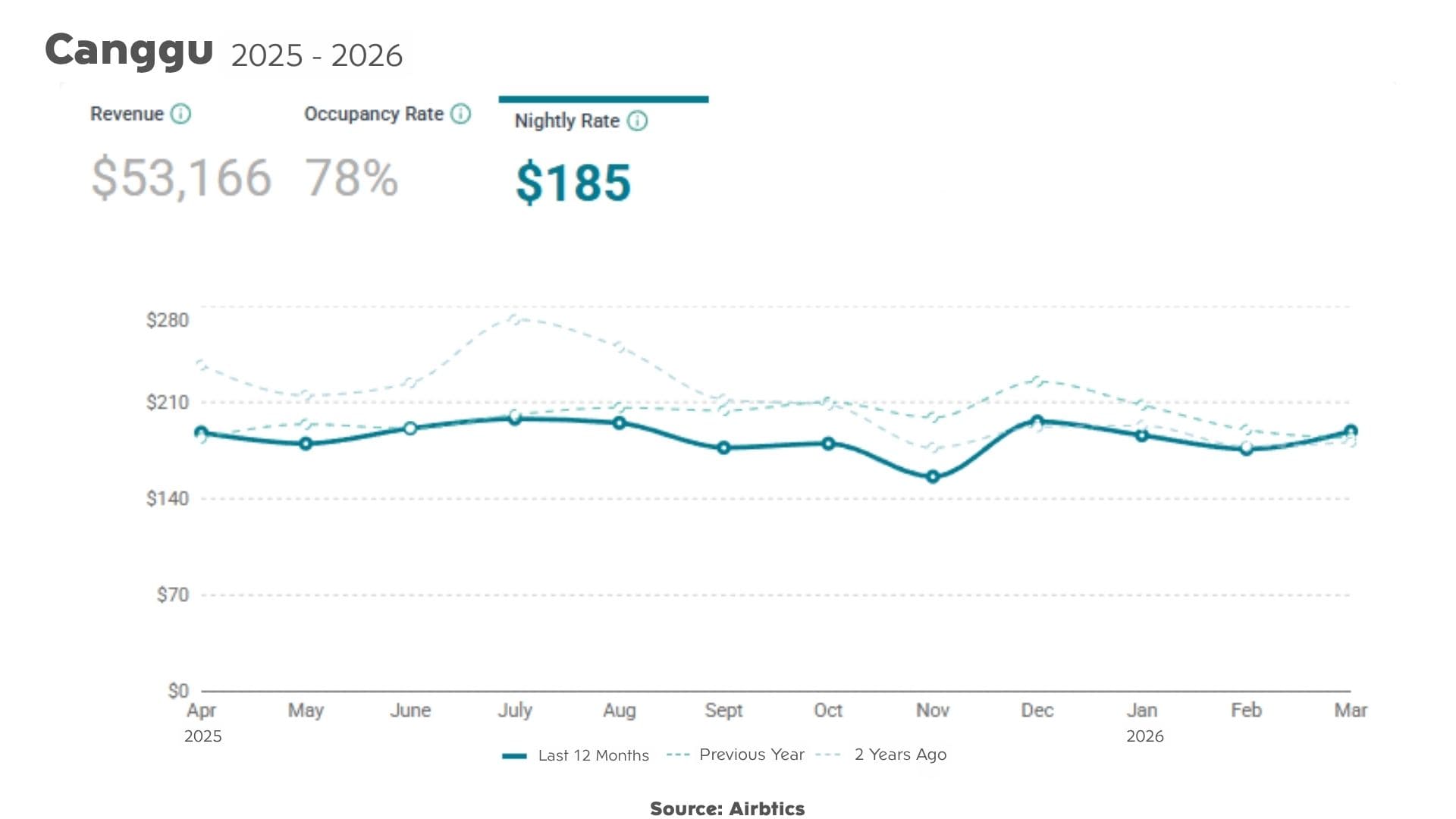
Canggu is currently operating at around 78% occupancy, with an average nightly rate of $185 or IDR 3.220.000. That combination is the key signal. In most cases, a listing base of this size would begin to dilute performance, pushing rates down as competition increases. In Canggu, that pressure is not materializing in the same way. The market is still holding close to four-fifths occupancy while carrying a large volume of active inventory, which points to a deep and active demand pool.
The monthly trend reinforces this. Over the past 12 months, occupancy rises into the high 80s and mid-90s during peak periods, then softens into the low 70s in quieter months before recovering again. The pattern is seasonal, but importantly, it is stable. Demand does not disappear, it redistributes. Even in slower periods, the market continues to move inventory rather than stalling.
In practical terms, this explains why investor attention remains strong even as entry prices increase. The appeal is not just lifestyle or branding. It is the demonstrated ability of the market to absorb supply, maintain booking activity through seasonal cycles, and preserve pricing power over time.

The Playbook - How to Think About Buying in Canggu
The first rule of investing in Canggu is to buy for convenience, not only for name recognition. A good location in the core is not just famous. It is friction-reducing. The easier the guest experience, the stronger the pricing power tends to be.
The second rule is to treat the beachfront core as a commercial asset zone, not just a lifestyle purchase. The market is too mature, too visible, and too competitive for generic product to feel safe. If a property cannot clearly justify why it belongs in a premium core location, the numbers become harder to defend.
The third rule is to understand that the core rewards clarity. Clear positioning. Clear access. Clear guest profile. Clear resale appeal. Batu Bolong and Berawa work because they are easy to explain to the market. That matters more than many buyers realize.
And finally, the winning mindset is not to ask whether Canggu is attractive. That question has already been answered by the numbers. The real question is whether the asset is in the part of Canggu that converts attraction into revenue most efficiently.
That is where Bali Home Immo can be positioned most effectively. Not just as an agency with stock in Canggu, but as a guide to the parts of Canggu where competition is highest, liquidity is strongest, and convenience carries real commercial weight. In a market this dense, knowing the difference between broad popularity and true investment quality is exactly what separates a good purchase from a strategic one.