





For decades, the name "Kerobokan" carried a heavy, specific association in Bali due to the infamous Class II-A Kerobokan Prison. However, a monumental infrastructural shift is currently rewriting the future of this district. As of April 2026, the Directorate General of Corrections (Ditjen PAS) and the Bali Provincial Government have officially begun the planning process of relocating Lapas Kerobokan to a new 11-hectare site in Melaya, Jembrana.
For real estate investors, this is a generational catalyst. The eventual removal of the prison complex will fundamentally transform the center of the district, paving the way for massive gentrification and redevelopment.
Kerobokan Is One of Bali’s Best-Connected Residential Areas
Kerobokan is not usually the first Bali place-name that gets turned into a lifestyle slogan. It sits perfectly nestled between Seminyak, Petitenget, Umalas, and Canggu, making it a primary choice for buyers who want to be "near everything" without living inside the high-intensity areas. Unlike the beach-club-heavy identity of Berawa or the boutique-led fame of Seminyak, Kerobokan is convenient and residential.
What Kerobokan Is Actually Like
While its neighbors are often designed to feel like a continuous vacation, Kerobokan feels like a home. It is significantly more residential than Seminyak or Berawa, making it far more practical for daily life. Here, the "Bali lifestyle" feels usable rather than just aspirational. You’ll find quieter lanes, local communities, and a layout that facilitates moving between districts with ease, attracting buyers who want their investment to function as a legitimate home base.
What Is in Kerobokan and What Is Nearby?
Everyday Convenience Is One of Kerobokan’s Biggest Strengths
The true luxury of Kerobokan is how effortlessly you can manage daily errands. You are never far from major anchors like Pepito Supermarket or Tiara Dewata for groceries. The area is packed with essential services, from local hardware shops to high-end interior boutiques.
For those with families, the access to international education is a major draw. You are within a short drive of Bali Island School and the numerous international preschools in Umalas. Unlike more isolated villa zones where a simple coffee run requires a commute, Kerobokan is dotted with local cafés and warungs that provide a genuine sense of community.
Close - But Not Inside the Heaviest Traffic
Buyers choose Kerobokan specifically for its role as a "connective tissue" between Bali’s most high-performing districts. It offers a unique dual-access lifestyle that few other areas can replicate.
-
The Seminyak & Petitenget Corridor: You are minutes away from the island's most established hospitality and premium dining anchors, such as Sardine or Metis, but you avoid the daily frustration of Seminyak’s primary traffic bottlenecks.
-
The Canggu & Berawa Hub: You have effortless access to the island's most famous gyms, creative hubs, and beach clubs like Finns or Atlas, yet you maintain the ability to retreat to the quieter, more affordable sanctuary of a Kerobokan villa.
Market Segmentation in Kerobokan:
Kerobokan caters to a diverse range of needs by offering a higher utility-to-price ratio than neighboring Seminyak or Berawa.
The Real Home Base: For the Long-Stay Resident
This segment is ideal for families and long-stay residents who prioritize functional living over being steps away from a beach club. In Kerobokan, the focus is on floor plans, storage, and residential comfort, features that are often sacrificed for "prime" positioning in denser tourist zones.
The Smarter Middle-Ground: More "Villa for the Money"
For investors and lifestyle buyers who want to remain within Bali’s west-side hub, Kerobokan represents a strategic middle-ground. You essentially get a larger footprint and better build quality for the same capital that would only secure a compact, high-traffic unit in Canggu.
So What Does the Market Look Like in Kerobokan?
Consistent Demand and High Occupancy
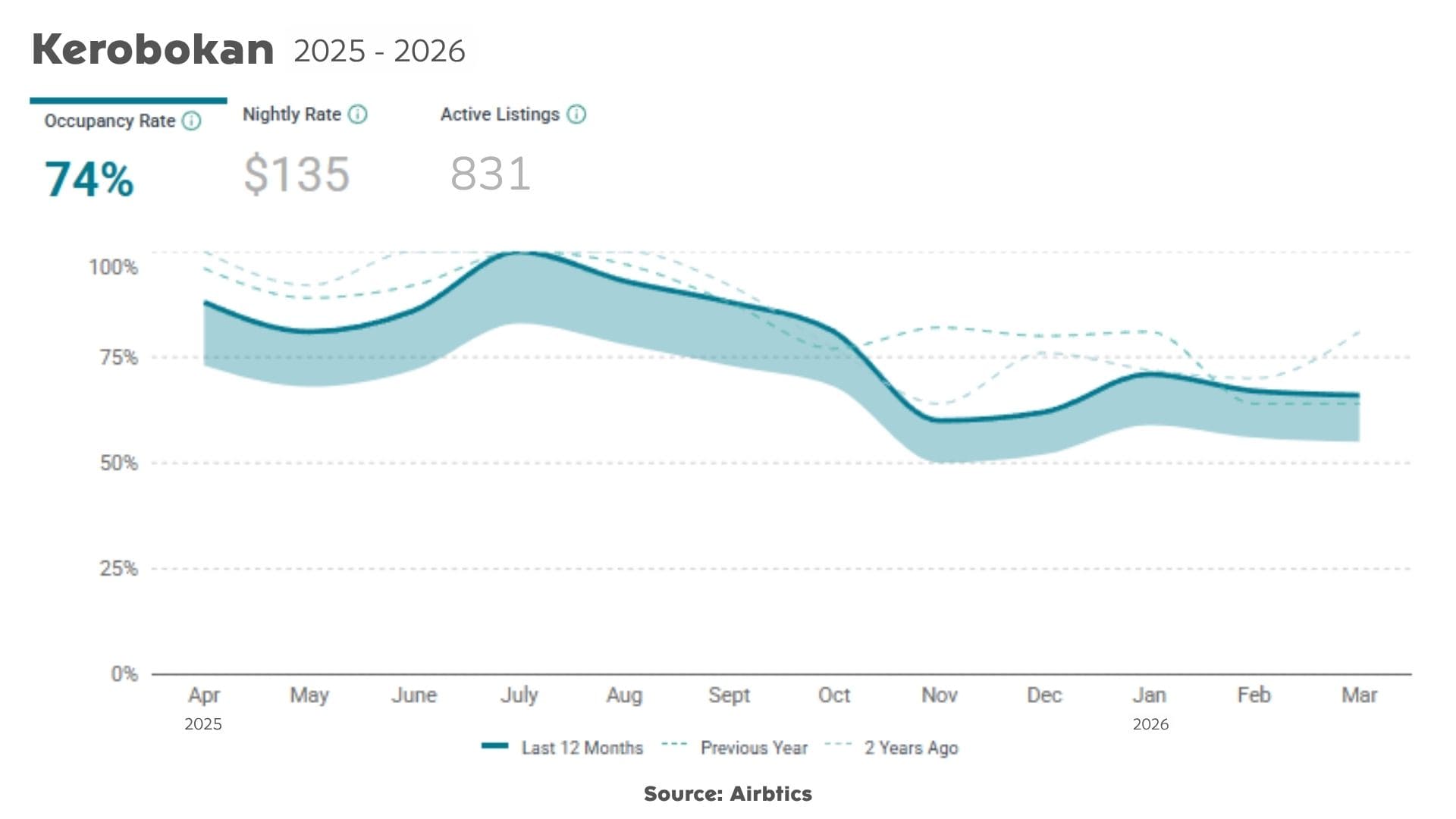
On the 2025-2026 market data, the numbers reveal a real estate ecosystem that is highly efficient, remarkably resilient, and fundamentally driven by its connective utility. Rather than relying on transient social media hype, the area proves its commercial worth through consistent, year-round demand.
Currently, Kerobokan maintains a robust 74% average occupancy rate across a massive pool of 831 active short-term and medium-term listings. This metric acts as the ultimate proof of concept for the region. It demonstrates clearly that a property does not need to be located on a primary beachfront strip to secure consistent, high-volume bookings. The demand for highly connected residential living is deep enough to sustain a massive inventory without suffering from market saturation.
When analyzing the seasonal occupancy curve over the previous twelve months, the data illustrates an area that successfully captures peak-season overflow. The occupancy rate surged aggressively during the July 2025 high season, pushing the market toward the 100% utilization mark. Following this peak, the market experienced an expected shoulder-season recalibration, settling near the 60% mark during the quieter month of November. Even at its lowest point, retaining a 60% occupancy baseline ensures that properties remain cash-flow positive, avoiding the severe dry spells that often affect purely speculative regions.
The Value Frontier Pricing Strategy
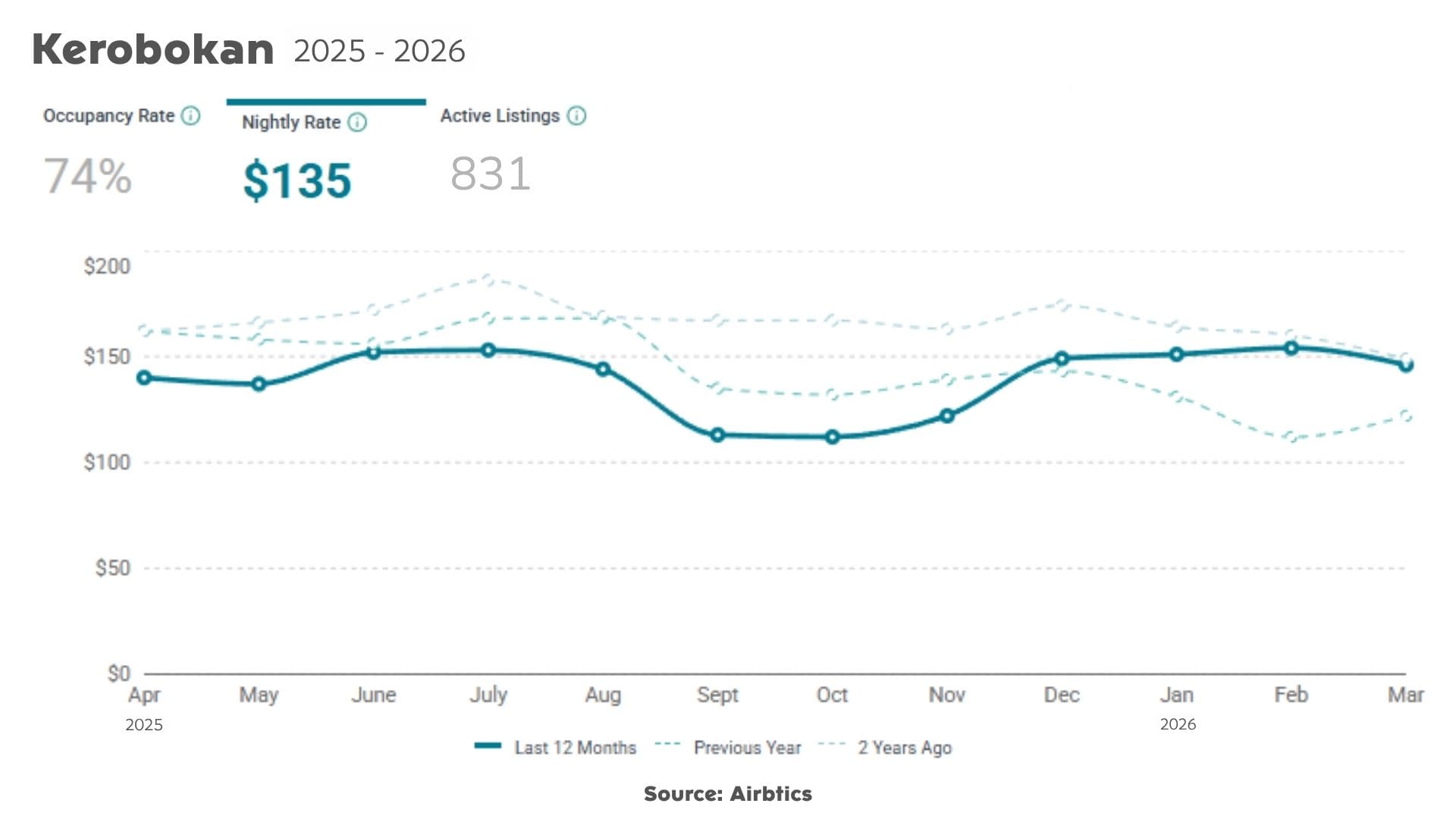
The pricing structure is exactly what makes this neighborhood so fiercely competitive for asset positioning. The average Nightly Rate (ADR) sits at a highly accessible $135 or IDR 2.346.000. At this precise price point, Kerobokan operates within a highly lucrative "Goldilocks" zone. It is affordable enough to consistently attract long-term digital nomads, remote workers, and value-conscious expatriate families, yet high enough to generate meaningful revenue for owners capitalizing on the area's lower land acquisition costs.
The revenue potential flexes naturally in tandem with broader market demand cycles. Nightly rates tracked the high seasons effectively, pushing past the $150 or IDR 2.607.000 mark during the mid-year summer peak from June through August, and experiencing a secondary surge during the December-to-February holiday rush. Conversely, during the transition months of September and October, average rates softened to approximately $110 or IDR 1.912.000. This deliberate pricing elasticity keeps the area attractive to long-stay tenants seeking favorable monthly deals during off-peak periods, ensuring calendar consistency when tourist arrivals momentarily dip.
The volume of 831 active listings indicates that Kerobokan is a fully matured residential sector. Because the audience prioritizes spatial functionality over beachfront proximity, developers can focus capital on interior quality rather than exorbitant land premiums. By operating at a 74% occupancy rate alongside a $135 or IDR 2.346.00 nightly average, the statistics prove that practical everyday convenience is a bankable asset. It provides a sustainable alternative to the hyper-competitive coastal strips.
A Regional Peer: The Canggu Northside Parallel
To fully grasp the strength of the residential market, it is useful to look at a direct neighboring parallel: the Canggu Residential Side (North). This area operates on nearly identical investment logic to Kerobokan, proving that the demand for functional, connective living extends across the entire northern perimeter of the coastal hotspots.
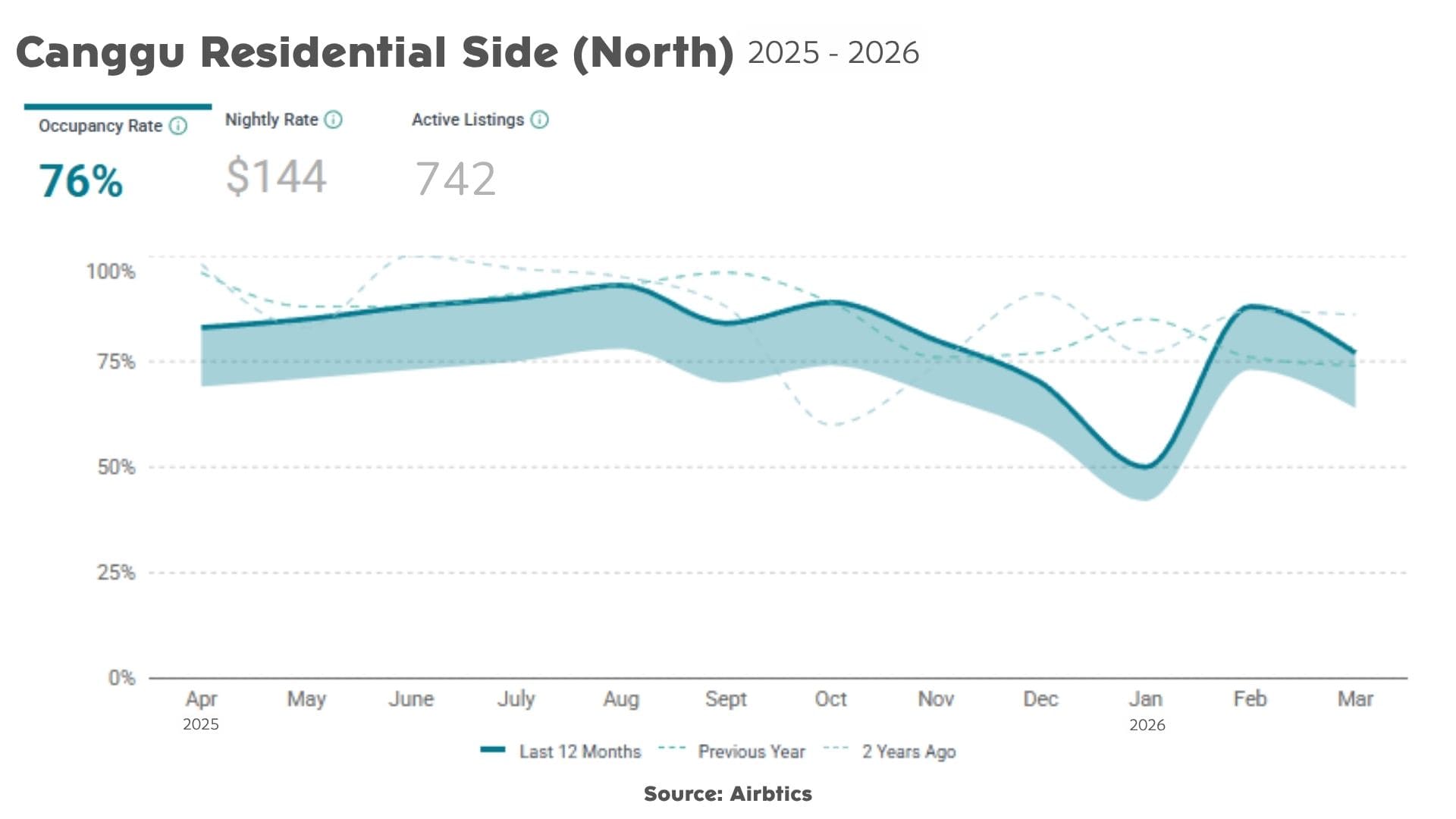
The performance metrics of the Canggu Northside mirror Kerobokan’s stability almost perfectly. The northern residential sector currently commands a 76% occupancy rate across 742 active listings. This closely aligns with the 74% occupancy seen in Kerobokan, confirming that the volume of demand for inland residential assets is widespread and highly consistent. Furthermore, the nightly rate in the Northside averages $144 or IDR 2.500.000, maintaining a slight premium but operating in the exact same accessible pricing tier that attracts long-stay professionals and families.
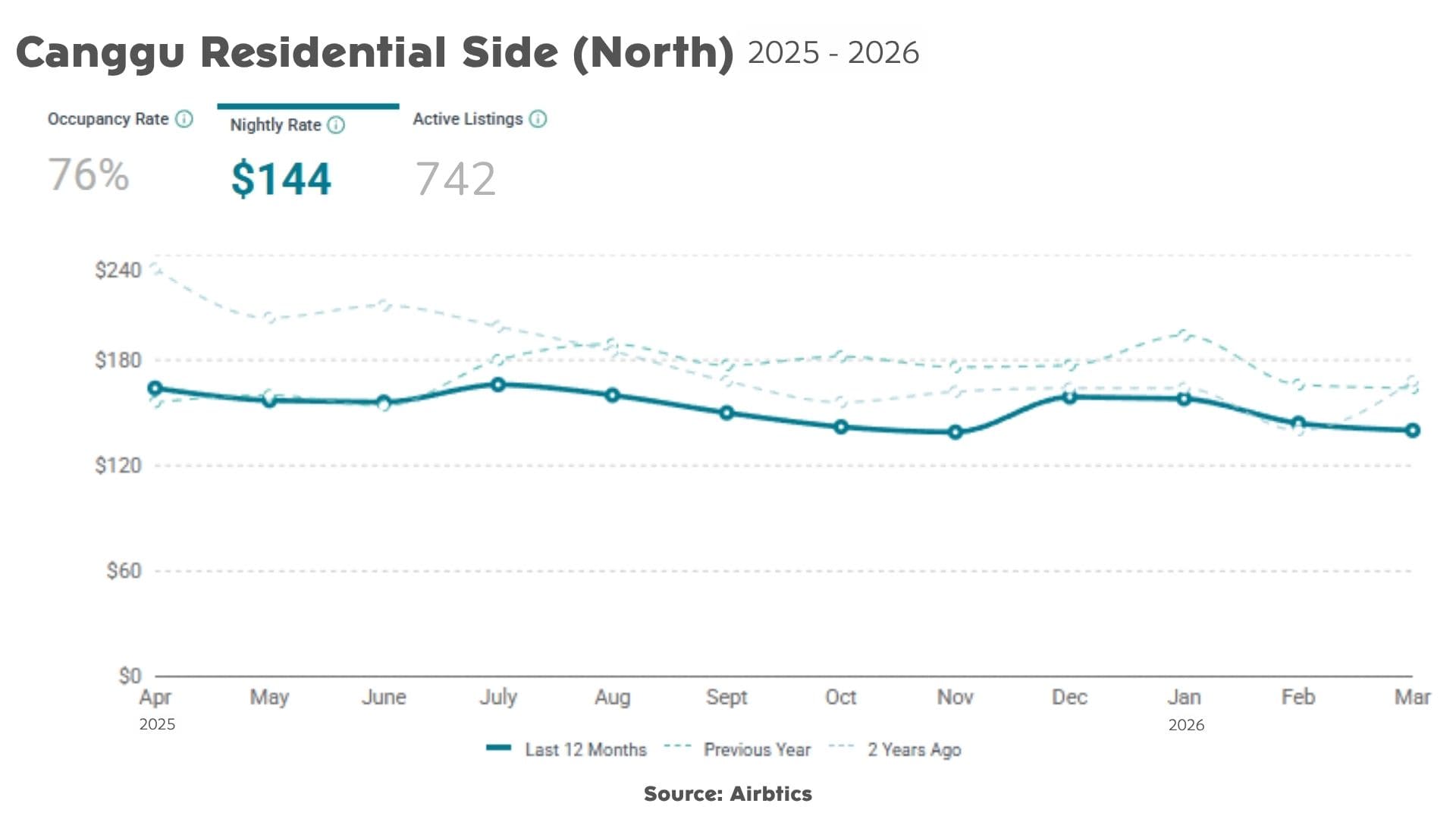
Seasonal trends further highlight the behavioral similarities between these residential peers. Just like Kerobokan, the Canggu Northside experienced a slight surge in occupancy during the July and August high season, pushing near full capacity. Nightly rates also expanded during this peak, cresting above the $160 or IDR 2.780.000 mark before gracefully softening to the $130 or IDR 2.260.000 range during the shoulder months of October and November. Even during a sharp occupancy recalibration in January, the market demonstrated the fundamental elasticity required to quickly rebound by February and March.
These parallel datasets validate a broader market truth. Whether positioned in Kerobokan or the Canggu Northside, properties focused on residential utility and strategic positioning consistently capture high-yielding demand. The residential perimeter is no longer merely an alternative; it is a proven, primary asset class.
What Makes Kerobokan Different?
Less Branded, More Practical
Seminyak is image-led; Petitenget is hospitality-driven; Berawa is socially intense. Kerobokan, by contrast, is grounded. It’s the area for buyers who want a home that works for them on a Tuesday morning, not just a Saturday night. Kerobokan’s ability to "shortcut" between Canggu and Seminyak is a value that becomes more apparent the longer you live in Bali.
When evaluating Kerobokan alongside the Canggu Northside, the performance parallels are striking. Both regions have successfully decoupled from the high-intensity, short-term tourism model, prioritizing longevity and daily function over beachfront hype. Both areas prove that the demand for "Practical Luxury" is a dominant market force. They capture the exact same demographic: remote professionals, value-conscious families, and long-stay expatriates who require high-spec, enclosed living and functional floor plans.
Connectivity vs. Sanctuary
The true distinction between the two lies in their geographic atmosphere and the specific lifestyle flavor they provide.
Kerobokan is fundamentally urban-adjacent and logistically focused. Its greatest asset is being the ultimate "connective tissue", a literal shortcut between the Seminyak hospitality corridors and the Canggu lifestyle hubs. It is intentionally unbranded, highly efficient, and built for maximum mobility. It is the choice for those who view the entirety of South Bali as their playground and want the easiest access to all of it.
Kerobokan is the Strategic Choice For investors or lifestyle buyer, the decision comes down to daily routing. If the goal is maximum multi-district access and pure, unpretentious utility, Kerobokan is the unmatched middle-ground. If the priority is a quieter, greener aesthetic while explicitly retaining the prestige of the Canggu postcode, the Northside is the definitive play.