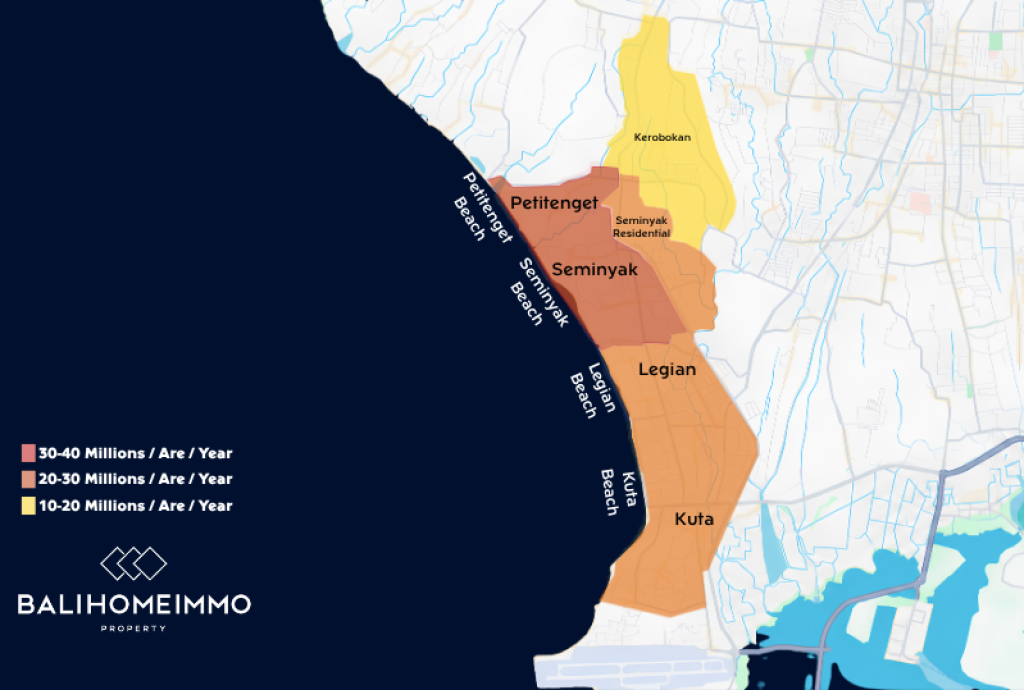






For years, the international investment community has treated "Seminyak" as a single, monolithic entity. It was viewed as the ultimate blue-chip destination, a uniform grid of high-end hospitality and guaranteed rental yields. However, as the Bali real estate market matures through 2026, treating Seminyak as a singular market is an amateur mistake that leads to misallocated capital and skewed revenue projections.
Seminyak has evolved into a complex ecosystem of distinct micro-economies, each operating with totally different logistical rhythms, guest demographics, and, most importantly, land acquisition costs. Relying on "blended averages" for the entire region masks the true financial realities on the ground. A general Seminyak ROI calculation dangerously blends the ultra-luxury data of the coastal strips with the pragmatic utility of the inland residential zones, giving investors a distorted view of what their capital can actually achieve.
To execute a smart investment in 2026, capital must be deployed with surgical precision. By segmenting Seminyak into three distinct pillars, Beachside (Oberoi), Petitenget and Batu Belig, and Seminyak Residential, we can accurately map revenue potential against the reality of current land lease rates.
Seminyak Beachside & Center (Oberoi)
The absolute core of Seminyak, encompassing the famous Oberoi strip and the immediate beachside grid, remains the undisputed high-volume anchor of South Bali. This is the "Classic Bali" premium zone, defined by its walking proximity to famous spots in Bali, premium retail on Eat Street, and the immediate shoreline.
The Revenue and Occupancy Engine
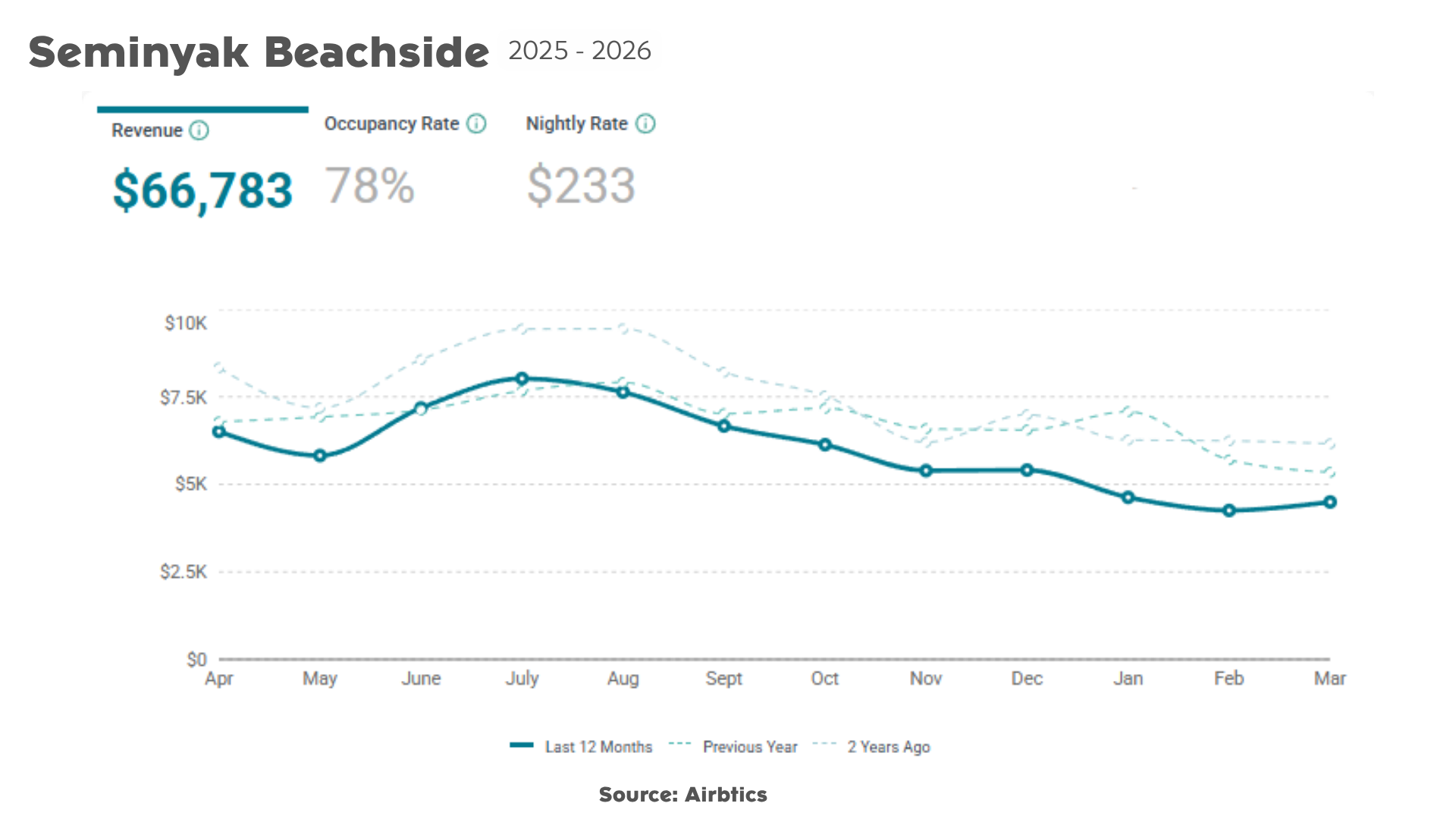
The data above reveals exactly why institutional and private wealth continues to anchor here. Seminyak Beachside maintains a phenomenal 78% average occupancy rate. This is a staggering utilization metric for a market of this size, proving that the demand for prime, central positioning is virtually recession-proof.
This relentless demand sustains an Average Daily Rate (ADR) of $233 or IDR 4.077.000, driving an impressive annual gross revenue average of $66,783 or IDR 1.169.000.000 per listing. The guest avatar here is the high-turnover, short-term vacationer. They are paying a premium strictly for geographic convenience, the ability to step out of their villa and immediately integrate into Bali’s most established hospitality corridor without ever needing to start a scooter.
The Acquisition Math for this blue-chip stability comes with the highest barrier to enter. Current market data places land in the Seminyak Center and Oberoi zone at around IDR 35.000.000 per are, per year for plots under 10 are. For larger developments exceeding 10 are, the rate compresses slightly to IDR 25.000.000 - IDR 30.000.000 per are, per year.
If an investor secures a standard 3-are plot for a 25-year lease at the baseline rate, the land acquisition alone requires a massive upfront capital injection. The way to face this situation here is not about finding a "deal" or hunting for rapid capital appreciation; it is about securing a highly defensive asset. You pay the absolute top of the market for the land because the 78% occupancy rate guarantees immediate, high-velocity cash flow from day one.

Petitenget & Batu Belig
Moving slightly north, the corridor connecting Petitenget to Batu Belig represents the pinnacle of Seminyak’s upscale maturation. This zone serves as the critical transitionary bridge between the legacy luxury of Seminyak and the modern, high-intensity lifestyle hubs of Canggu's Berawa.
The Premium Pricing Strategy
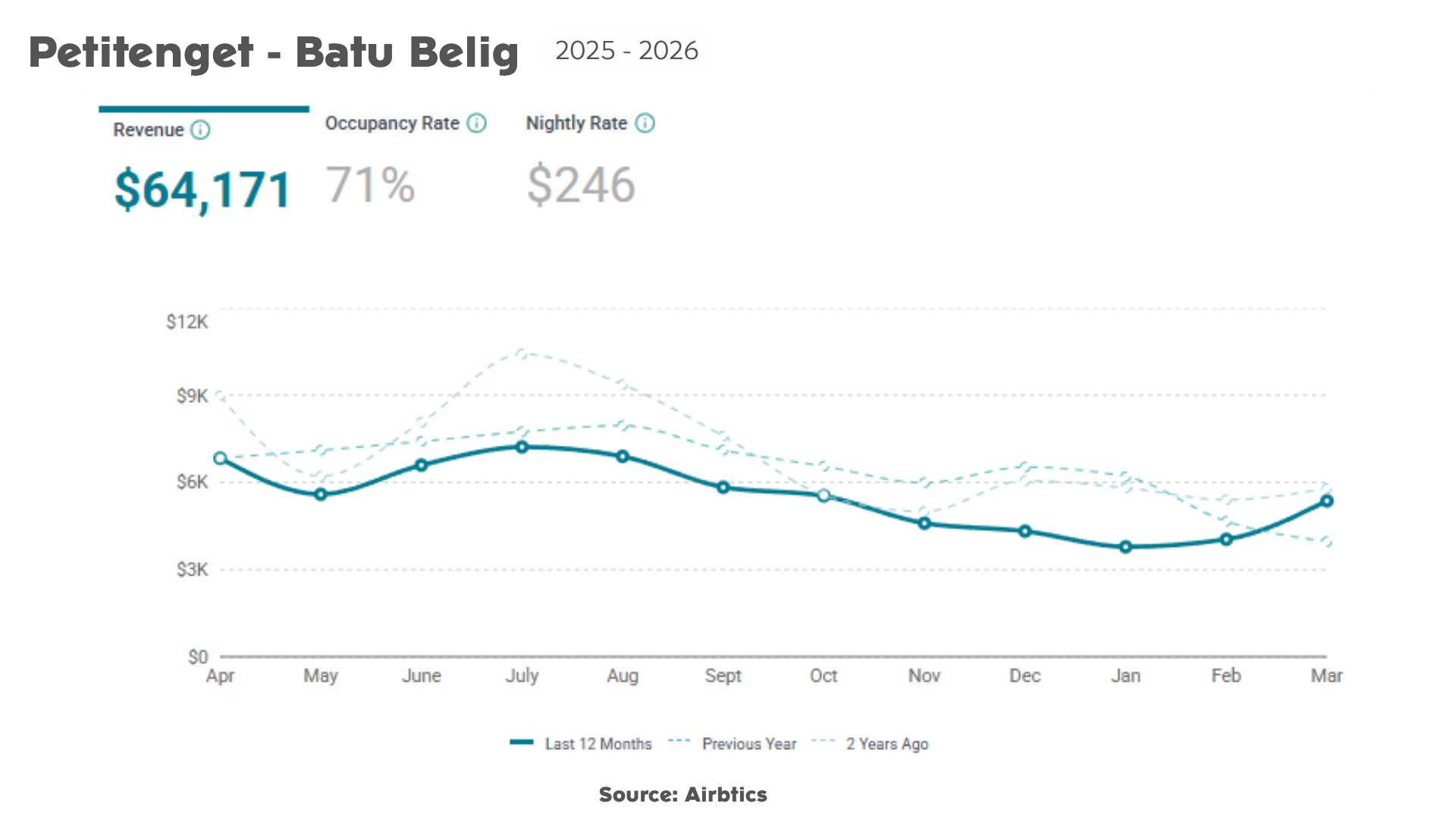
While it operates at a slightly lower occupancy rate than the Oberoi core, sitting at a highly respectable 71%, Petitenget and Batu Belig completely dominate the pricing structure. This micro-market commands the highest Average Daily Rate in the region at $246 or IDR 4.304.000. This elevated ADR generates a robust annual revenue of $64,171 or IDR 1.123.000.000, keeping it in tight financial parity with the Oberoi areas despite the lower volume of booked nights.
The guest demographic here is the sophisticated "lifestyle traveler." They are slightly older, possess a higher disposable income, and actively seek out proximity to ultra-premium dining and beach clubs like Potato Head, W Bali, and Mari Beach Club.
The Product Requirement and Land Cost
Because the guest expects a $246 or IDR 4.304.000-per-night experience, standard "cookie-cutter" villas fail here. Capital deployed in this zone must be heavily weighted toward high-end architectural builds, imported finishes, and immaculate interior design.
Fortunately, the land acquisition costs provide a slight margin of flexibility compared to the Oberoi center. Parcels up to 10 are are currently trading between IDR 30.000.000 to 35.000.000 per are, per year. Larger plots follow the same IDR 25.000.000 - 30.000.000 ceiling. That IDR 5.000.000 per are difference on the lower end allows savvy developers to reallocate funds from land acquisition directly into the premium construction quality required to defend that $246 ADR or IDR 4.304.000.
Seminyak Residential
The most fascinating, and arguably the most lucrative, data point in the 2026 market analysis belongs to the Seminyak Residential zone. This inland sector sits safely behind the main commercial arteries, entirely removed from the immediate beachside hype. Yet, it operates as a ruthlessly efficient yield generator.
The 76% Resilience Factor
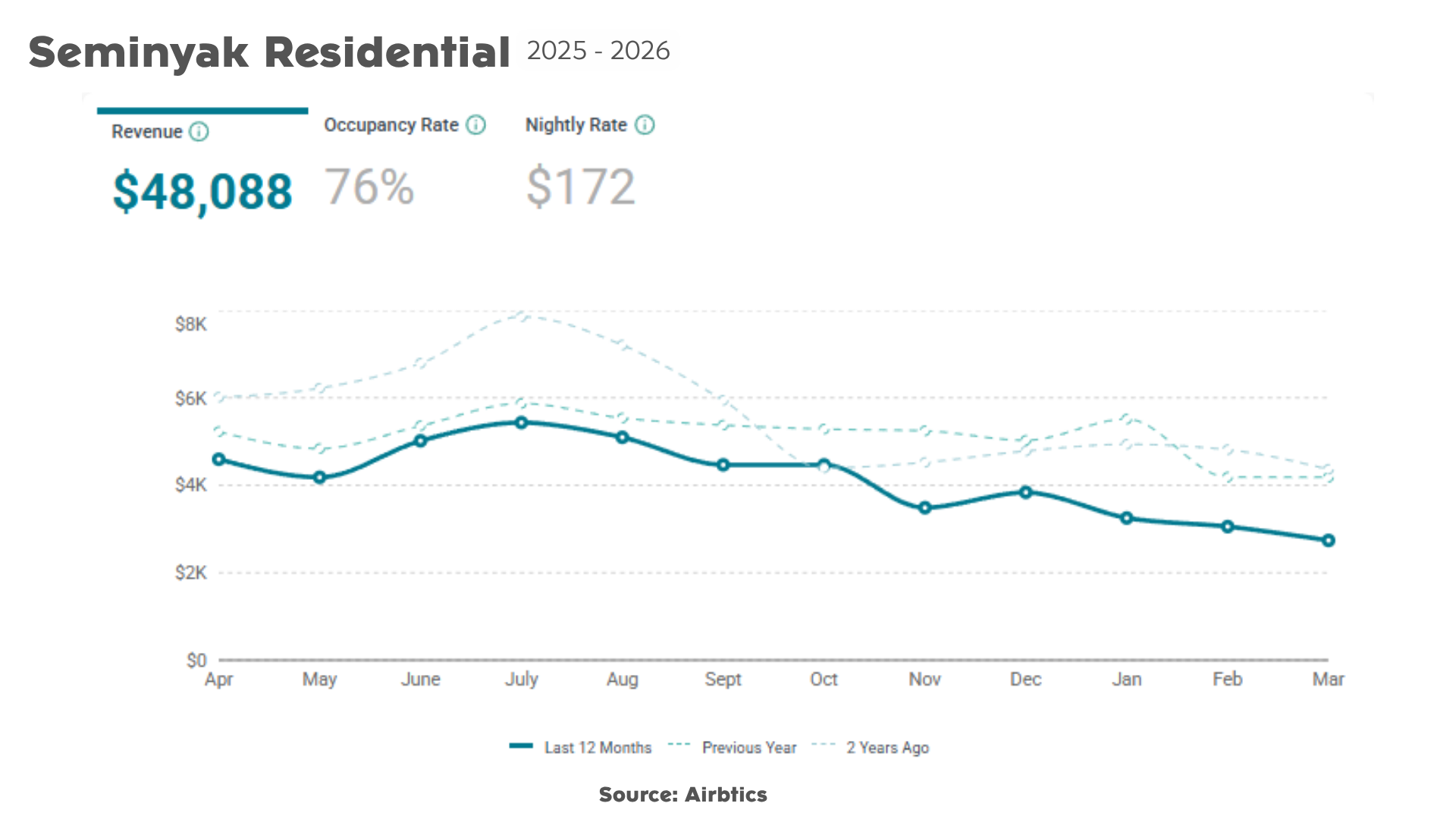
The data shatters the misconception that beach proximity is the only driver of high occupancy. Seminyak Residential commands a massive 76% occupancy rate, performing almost identically to the premium Oberoi beachside. This proves unequivocally that practical, functional living is just as bankable as immediate ocean access.
This zone operates in the ultimate pricing "Goldilocks" zone. With an accessible ADR of $172 or IDR 3.000.000, it generates a stable $48,088 or IDR 841.425.000 in annual gross revenue. This pricing perfectly captures the rapidly expanding middle-ground demographic: long-stay digital nomads, expatriate families, and frequent Bali visitors who prioritize residential comfort, quiet workspaces, and grocery access over being steps away from a nightclub.
The Unmatched Utility-to-Price Ratio
The true brilliance of the Seminyak Residential market lies in its acquisition costs. Land in this zone is dramatically more affordable, currently priced at IDR 20.000.000 per are, per year for plots under 10 are, and dropping to a highly efficient IDR 15.000.000 - 18.000.000 per are, per year for larger parcels.
When you compare the capital required to secure a 4-are plot here versus the Oberoi zone, the savings are staggering. Investors essentially get significantly more "villa for the capital." By paying nearly half the land lease rate of the coastal strip but still capturing a 76% occupancy rate, the gross yield percentages in the residential sector frequently outperform the premium zones. It is the smartest play for investors prioritizing rapid ROI over prestige branding.

Aligning Capital with Strategy
Investing in Seminyak in 2026 is definitely an exercise in aligning your capital profile with the correct micro-market.
-
The Wealth Preservation Play (Seminyak Beachside/Oberoi): If your primary goal is blue-chip stability, high-velocity short-term rentals, and you have the heavy capital required to absorb the IDR 35.000.000 per are entry cost, the Oberoi core is unmatched. Its 78% occupancy provides a defensive shield against market fluctuations.
-
The Premium Hospitality Play (Petitenget & Batu Belig): If your strategy is to build a high-end, architectural masterpiece, this is where you build it. The land costs offer slight relief (IDR 30.000.000 - 35.000.000), and the market actively rewards luxury with a leading $246 or IDR 4.304.000 ADR. It is the zone for maximum top-line revenue per guest.
-
The Aggressive Yield Play (Seminyak Residential): If your spreadsheet is focused purely on maximizing the percentage yield against your initial capital expenditure, the residential zone wins. Acquiring land at IDR 20.000.000 per are while capturing 76% occupancy provides the widest profit margin in the region.
Ultimately, Seminyak’s best location is not determined by geography alone. By moving past the monolith and understanding the distinct relationship between land costs and operational revenue, ensuring your capital is positioned for absolute returns becomes a little less of a blind date with an Excel spreadsheet and more of a calculated conquest.