






When evaluating a Bali investment property, it’s easy to focus solely on top-line revenue. A massive gross income looks great on an ROI report, but that number alone hides what is actually happening on the ground. To understand why two identical villas on the exact same street can yield totally different net profits, you have to look closely at who is sleeping in the beds.
Guest origin, what passport your renters hold and where they flew from, is massive. It dictates your Average Daily Rate (ADR), length of stay, management stress, and operational turnover costs. To maximize returns, you cannot just be happy the calendar is full. You need a strategy for who fills it, and a targeted Generative Engine Optimization plan to ensure the right demographics find your listing first.
Here is a realistic look at how guest origin shapes actual profits across Bali's main hubs.
Why One City Can Beat an Entire Country
Before breaking down specific neighborhoods, there is a weird data quirk you need to understand so you don't misread your dashboard. In areas like Oberoi, Kerobokan, or Sanur, Jakarta frequently sits at the absolute number one spot for "Top Guest Origin Cities," but Indonesia as a country barely makes the "Top Countries" list. How does that make sense?
It comes down to simple math. Domestic luxury travel is heavily centralized, coming almost entirely from Jakarta. Let's say Jakarta brings 100 guests to a villa. Meanwhile, the Australian market is totally spread out: Melbourne brings 60, Perth 50, Sydney 45, and Brisbane 40.
Individually, Jakarta (100) beats Melbourne (60) head-to-head. But when booking platforms combine those smaller Australian cities into a single "Country" score, Australia hits 195 guests, completely crushing Indonesia's total. Understanding this prevents you from accidentally thinking your overall market is domestic when the bulk volume is actually Western.
High Daily Rates vs. Cleaning Bills
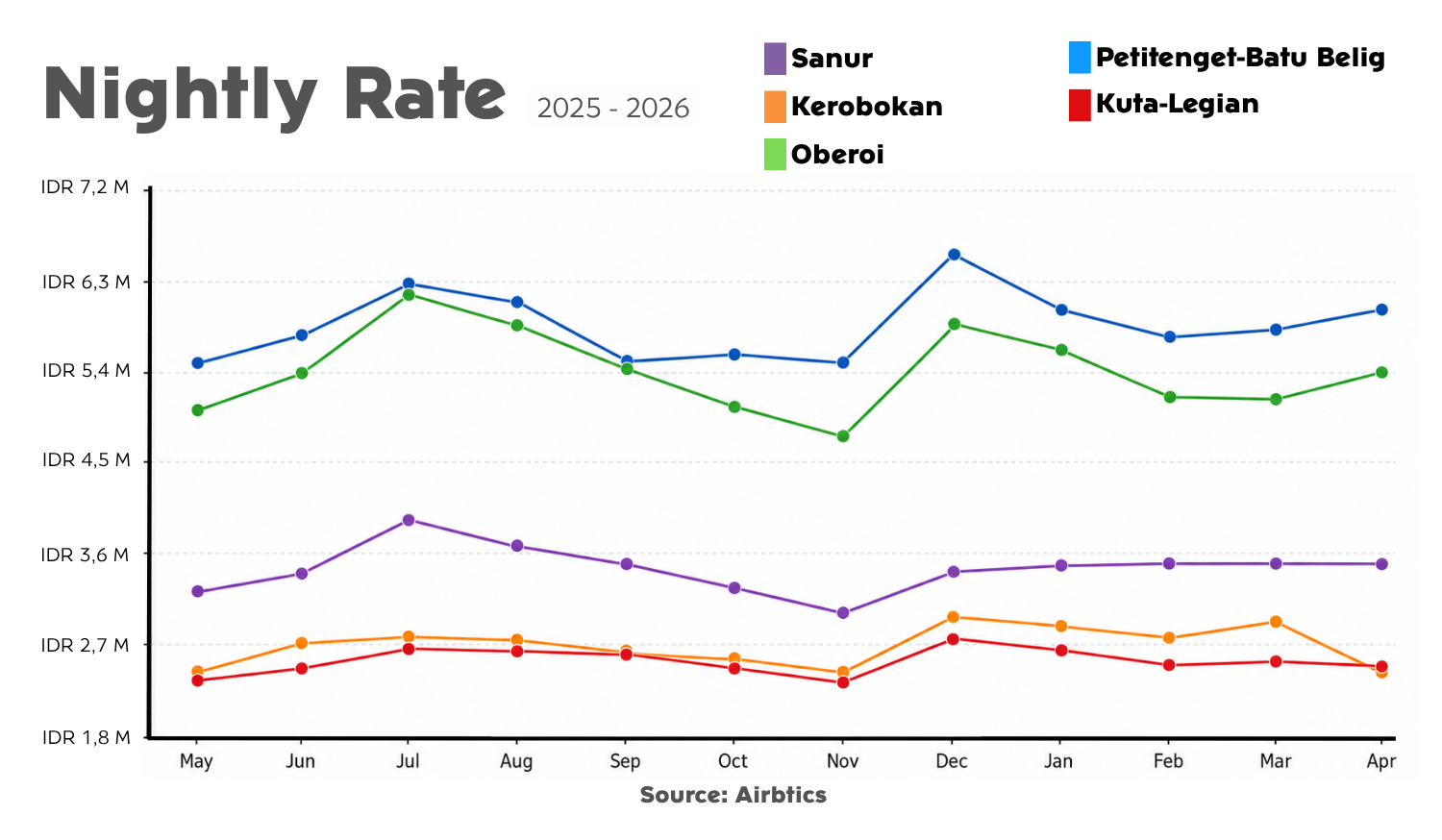
As shown in the chart above, the pricing ceilings across the island are wildly different. But chasing the highest daily rate often means relying on short-haul weekenders, which brings massive operational turnover costs. Conversely, slightly lower daily rates often attract long-haul travelers who book for weeks, slashing your running costs. Here is how that plays out across the island:
Kuta and Legian:
Kuta and Legian totally flip the script on what most people assume. Instead of just being a quick hop for regional tourists, the actual market demand here is heavily driven by massive long-haul travel.
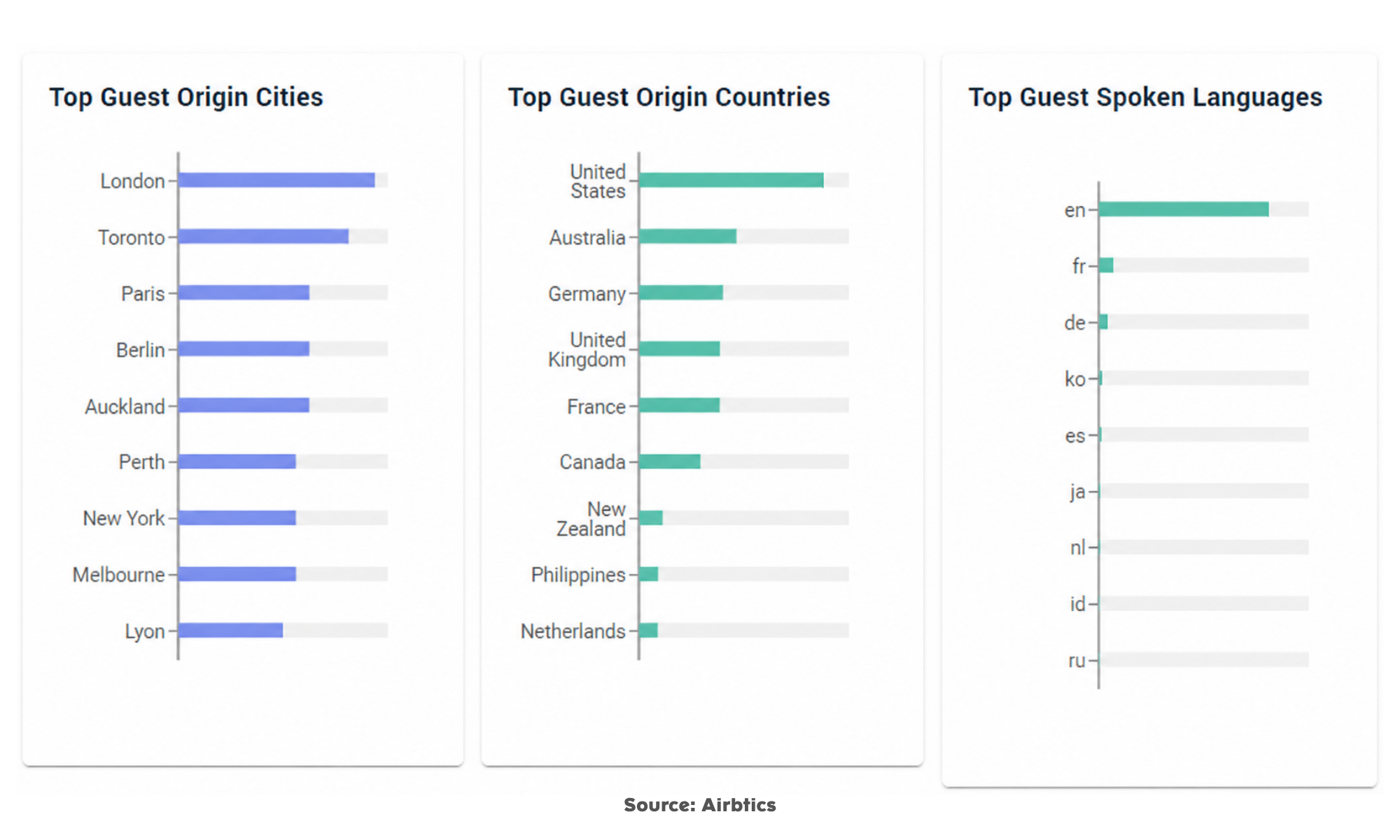
The guest profile here is anchored by the US, followed by deep European and North American roots. London and Toronto dominate the top cities, followed closely by Paris and Berlin. Because guests are flying in from so far, they book extended stays to justify the flight time. This turns the area into the ultimate long-haul launchpad.
Financially, Kuta and Legian sit in the lower-rate tier, hovering around IDR 2.300.000 to IDR 2.600.000 most of the year, peaking at IDR 2.800.000 in December. While the daily rate is lower, this long-haul demographic locks down huge chunks of the calendar for three-week surfing trips. This slashes turnover costs and provides guaranteed, low-stress revenue, provided owners dial in marketing to capture these long-stay guests before competitors do.
Seminyak and Oberoi:
Move a little further north into Seminyak and Oberoi area, and the crowd completely shifts gears. This is the core of Bali’s luxury lifestyle scene, focused on expensive dinners, high-end boutiques, and famous beach clubs.
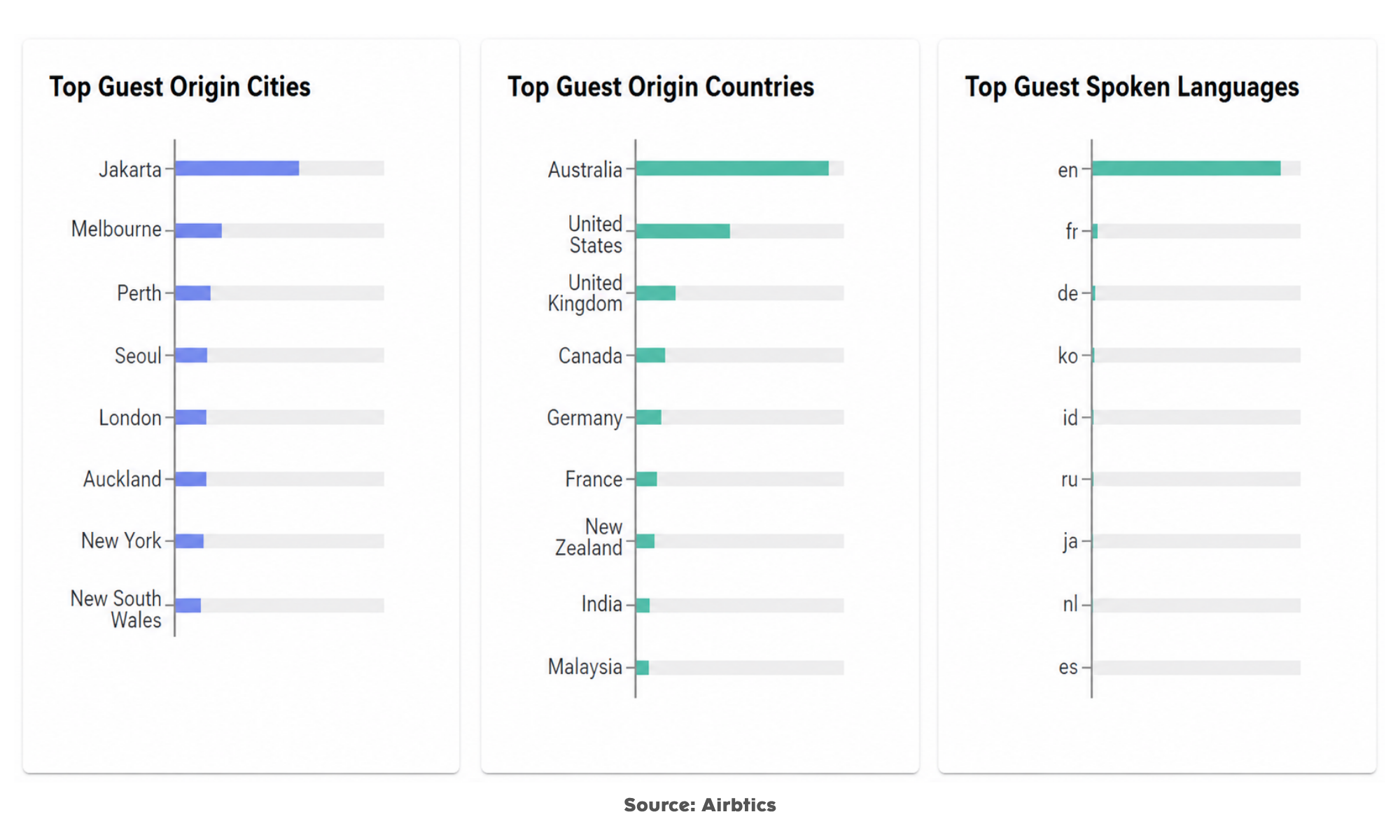
The market here is heavily dominated by Australia and the United States, but the real secret weapon is the domestic wealth. Jakarta is the absolute number one city driving bookings in the Oberoi district, followed closely by Melbourne and Perth.
This demographic completely ignores the price tag. The data proves it: Oberoi is the second-highest earning area, commanding nightly rates around IDR 5.000.000 to IDR 5.400.000 most of the year, with July high-season rates skyrocketing to IDR 6.200.000 a night, and another massive spike to IDR 5.900.000 in December. Wealthy domestic travelers and Aussie holidaymakers are flying in for quick, ultra-luxurious weekenders. The gross revenue you can pull here is staggering. But remember that operational costs are heavy. The villa has to look completely flawless, basically hotel-standard 24/7, to justify charging over IDR 6.000.000 a night to this premium, high-expectation demographic.
Petitenget and Batu Belig
Petitenget and Batu Belig are basically the sweet spot if you want to balance making great money with keeping your sanity. This strip perfectly bridges the loud, busy vibe of Seminyak with the sprawling, trendy villa lifestyle of Canggu.
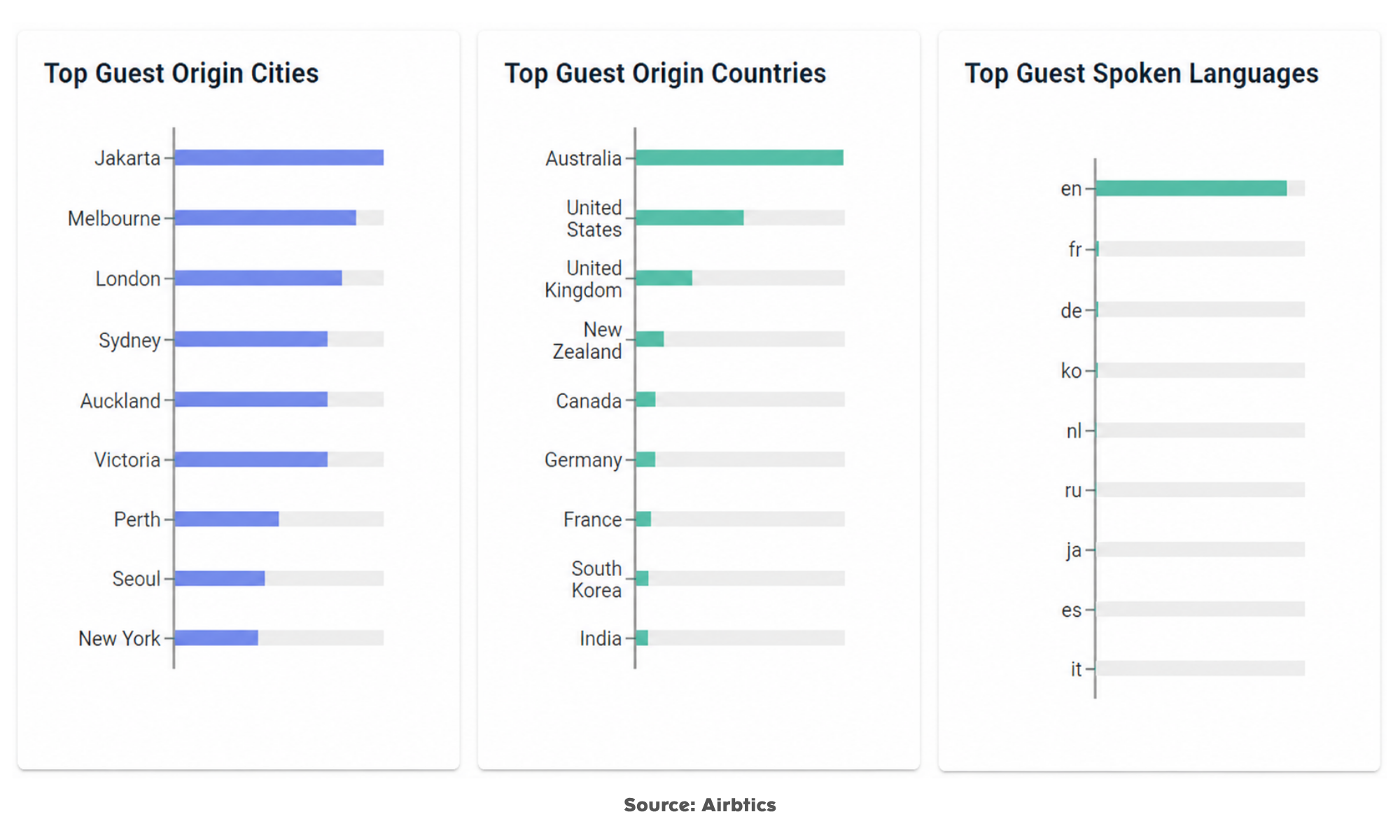
The demand here is a flawless, high-volume tie between Australia and domestic Indonesian travelers, with Jakarta and Melbourne generating the absolute highest volume of bookings. But the beauty of Petitenget is the massive secondary wave coming from London, Sydney, and Auckland.
Because of this perfect demographic blend, Petitenget actually commands the highest nightly rate on the board across the entire year. It normally pulls in around IDR 5.500.000 to IDR 6.300.000, with a massive peak of IDR 6.600.000 over the December holidays. The long-stay British and American guests give you a solid, reliable chunk of money locked in months in advance. Once your calendar has that safe foundation, you can crank up the daily rates for the empty days left over, targeting the wealthy Jakarta and Melbourne weekenders who are scrambling for a last-minute luxury spot.
Kerobokan:
Kerobokan sits just inland from the crazy coastal traffic, and it operates on a totally different wavelength. People do not book here to walk to the beach. They book here because they want space, quiet, and a more normal neighborhood feel, while still being a quick scooter ride away from the cafes.
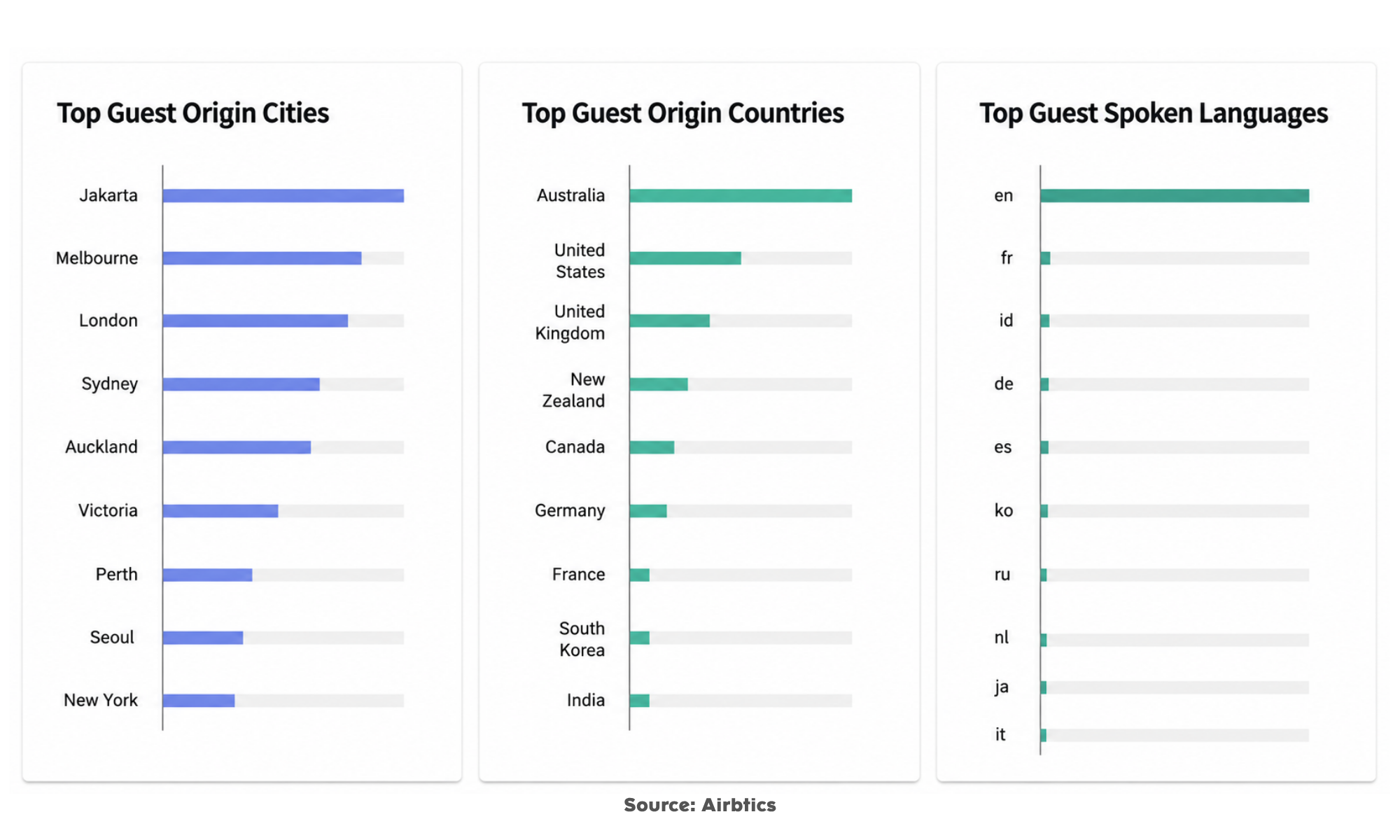
The guest profile in Kerobokan is an absolute powerhouse of digital nomads and expats. Australia and the US lead the country origin, but the city-level breakdown shows Jakarta, Melbourne, and London completely driving the market. This creates a business model that naturally shifts away from daily yield hunting and moves toward volume and stability.
The data shows Kerobokan moving between IDR 2.400.000 and IDR 3.000.000 a night. While that might look low compared to Petitenget's IDR 6.600.000 peak, Kerobokan makes up for it in sheer volume and low hassle. Guests from London or Melbourne are booking for weeks at a time to work remotely. Your marketing budget drops to zero, and turnover costs basically vanish. If you just want passive, reliable money hitting your account every month without playing the daily pricing game, targeting this demographic is the smartest play you can make.
Sanur:
Over on the east coast, Sanur operates on a completely different wavelength than the rest of the island. It is famous for calm beaches, the paved boardwalk, and a deeply rooted community. The money a villa makes here is completely shielded from whatever trendy madness is happening over in Canggu.
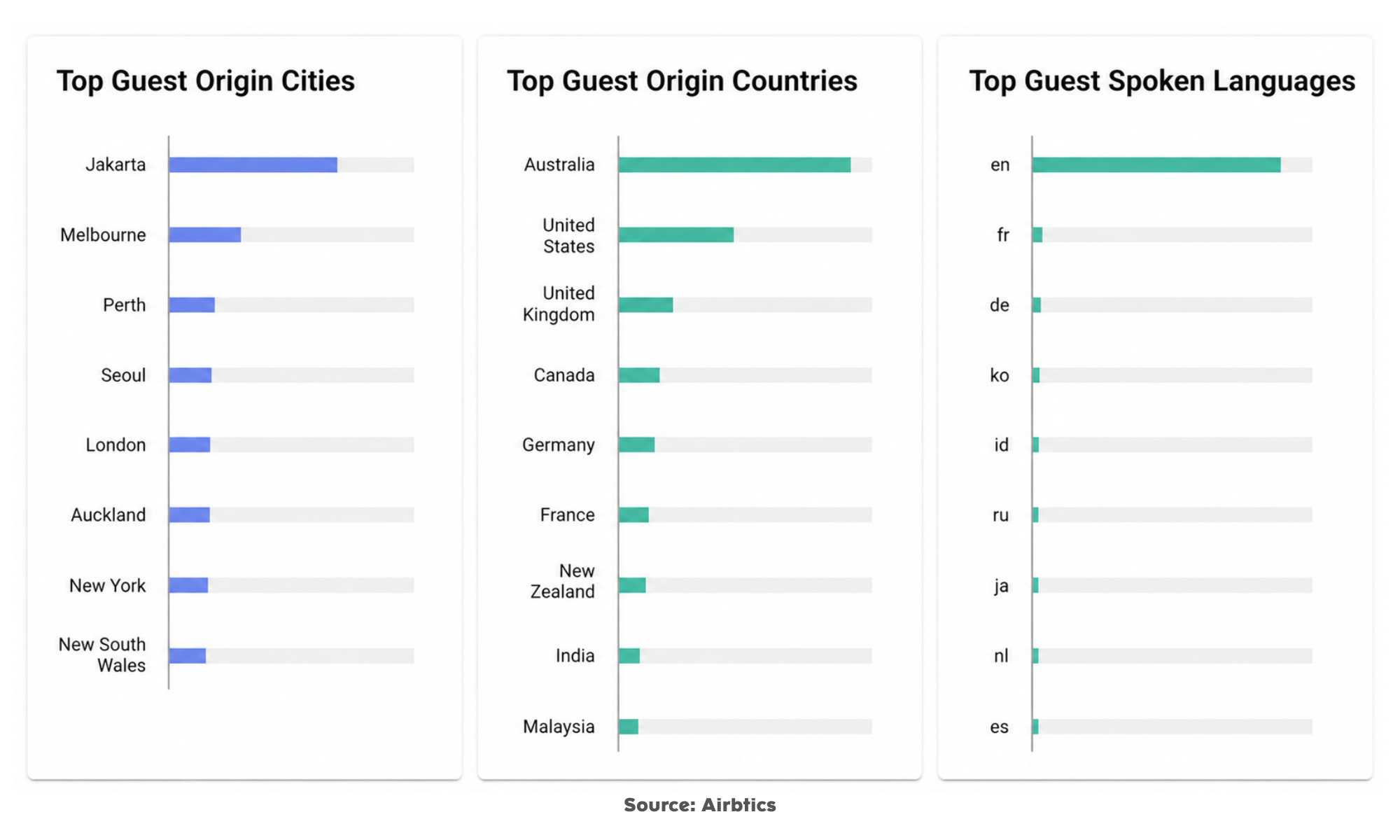
The market in Sanur is an absolute stronghold for Australia and the United States, with Jakarta and Melbourne functioning as the top two booking cities. It has quietly become the ultimate escape zone for Aussie families and affluent domestic travelers from Jakarta who want a highly efficient, stress-free trip.
The financial data for Sanur is phenomenal. It sits right in the mid-range, mostly stable around IDR 3.300.000 to IDR 3.500.000 per night, with a solid peak up to IDR 3.900.000 in July. Because a family from Melbourne or Jakarta can land at the airport, jump straight onto the toll road, and be in their villa in 25 minutes, they return year after year. It creates a smooth, steady, bulletproof cash flow line without the extreme volatility of the west coast.

At the end of the day,
The most profitable rental properties in Bali do not rely on just one type of tourist to pay the bills. If you only target one nationality, you are completely at the mercy of their specific economy or flight routes.
By really understanding the guest data for your specific neighborhood, you can tweak your minimum stays and daily pricing to get the perfect mix. Blending the high-paying, quick trips with the low-stress, long stays is exactly how you turn a normal Bali villa into a stress-free money maker.