





Once you know where the lines are drawn on the map, the next real test for any investor is looking at how a property actually performs on the ground. As we move through 2026, managing a high-yielding villa along the southwest coast has become a game of inches. Projecting your returns isn't a guessing game anymore; it is a predictable math equation driven by seasonal shifts, vacancy defense, and nightly rate ceilings.
Nowhere are these operational differences more intense than in the three biggest rental hotspots right now: Berawa, Batu Bolong, and Pererenan.
All three areas sit firmly in the island's premier performance bracket, anchoring what developers look at as the absolute peak of the rental market. This close proximity gives investors a unique advantage: while these neighborhoods share the same stunning coastline, each one has carved out its own distinct competitive edge. Their rental numbers, seasonal strengths, and target guest demographics offer completely different avenues for wealth generation.
Instead of looking at Canggu as just one big catch-all market, savvy owners can treat it as a highly localized economic ecosystem, allowing you to pick the exact neighborhood performance profile that perfectly aligns with your financial goals. Here is how these three heavyweights actually match up head-to-head based on real, trailing performance data mined across all standard property sizes, tracking everything from compact studio units up to large 5+ bedroom luxury estates.
The Pricing Power
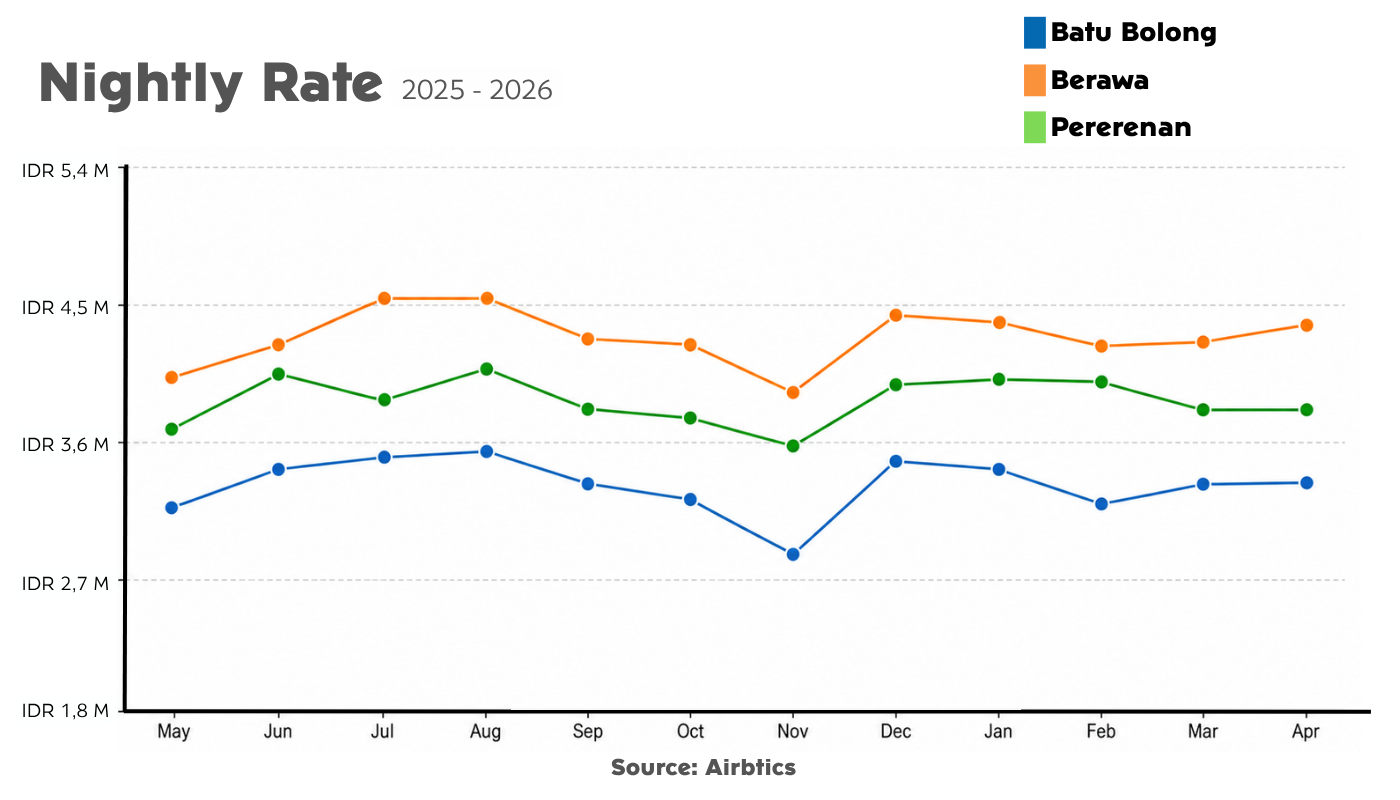
When you look at what villas actually charge per night, one major trend jumps out immediately: Berawa sets the absolute price ceiling, while Batu Bolong hits a hard, structural limit.
-
The Berawa Premium: Berawa is the undisputed heavyweight when it comes to pricing. It operates like a blue-chip corporate asset because of the massive lifestyle infrastructure anchoring the area. Its pricing power is crazy, even during its slowest month of the year (IDR 3.95 million in November), a Berawa villa still commands a higher nightly rate than the absolute highest holiday peak that Batu Bolong can manage all summer (IDR 3.55 million in August). Guests here are willing to pay top dollar for the sheer convenience of being steps away from the island's biggest beach clubs and high-end dining.
-
The Pererenan Sweet Spot: Pererenan sits comfortably right in the middle, balancing luxury with predictability. It holds a steady IDR 3.7 million to IDR 4.1 million for almost the entire year, tracking just behind Berawa without experiencing massive, scary price drops. It avoids the hyper-commercialized premium of Berawa but commands enough respect to keep rates consistently high.
-
The Batu Bolong Ceiling: This is where the numbers get tricky. Despite costing the exact same IDR 40M-50M+ per are to buy the land, Batu Bolong villas hit a strict structural limit. The market here is incredibly saturated with smaller, high-turnover spaces like studios and 1-bedroom layouts. As a result, it struggles to break past the IDR 3.5 million mark even during the absolute peak of Christmas and summer. When the low season hits, the competition forces a race to the bottom, dropping rates down to IDR 2.9 million just to capture bookings.

Occupancy Rates & The "Pererenan Defense"
While Berawa easily wins the battle on daily pricing, the occupancy rates tell the real story of how these properties operate on the ground. A high nightly rate means nothing if the villa is sitting empty. This is where The Pererenan Defense completely changes the game for investors.
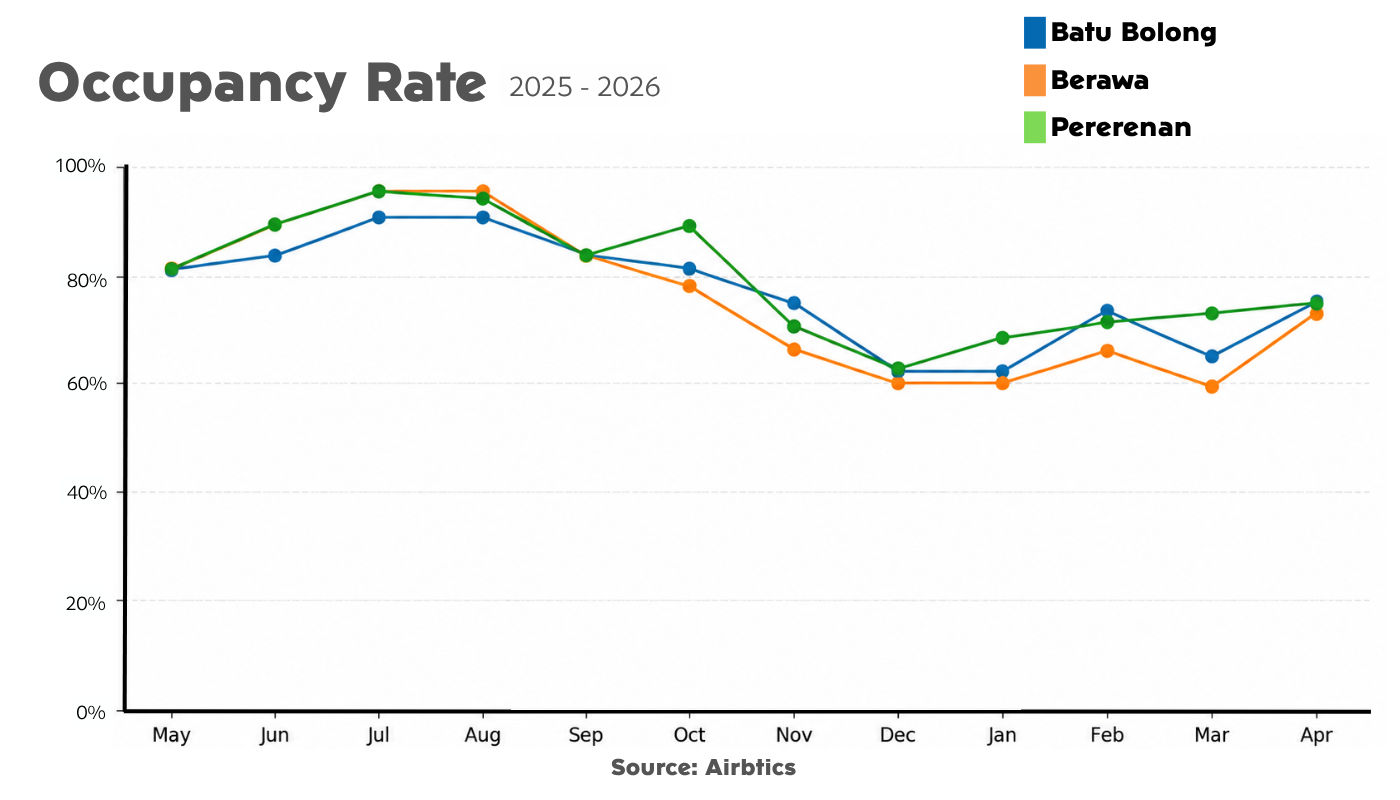
During the crazy summer rush in July and August, Berawa and Pererenan move completely in sync. Both areas fill up at a staggering 95% to 96% occupancy, while Batu Bolong follows just behind at a very healthy 91%. Everyone is making money. But look at what happens when the global holiday season cools down from October to April:
-
The October Shift: As the shoulder season kicks in, Pererenan holds an incredible 90% occupancy, brushing off the slowdown. Meanwhile, Berawa takes a hit, dipping to 79%, and Batu Bolong drops to 82%.
-
The Winter Crater: In January, the reality of the rainy season sets in. Berawa and Batu Bolong hit their absolute lowest points of the year at 60% and 63%. Pererenan, however, barely flinches, holding onto a very healthy 69% occupancy.
-
The March Gap: By March, Pererenan bounces back fast to 73% occupancy, while Berawa gets stuck in the mud at its absolute worst month of the entire year at 59%.
When you are paying a premium land price, holding an empty calendar during the low season is painful. While all three areas justify their upfront land costs during the summer rush by hitting 91% to 96% occupancy, the off-season tells a completely different story. Paying that high-tier land price in Berawa or Batu Bolong means you have to tolerate a rocky rainy season, where occupancy slides down to 59% and 63% around January and March. On the flip side, Pererenan acts as a defensive shield for your investment capital, holding onto a resilient 69% to 90% occupancy through the shoulder and wet months, ensuring that expensive land asset is consistently working for you year-round.
Why Pererenan Beats the Low Season:
The reason for this massive gap comes down to guest psychology. Batu Bolong and Berawa rely heavily on high-turnover tourism driven by party spots, massive beach clubs, and nightlife. When the seasonal vacation waves stop and the weather turns, their calendars empty out quickly.
Pererenan operates on a completely different wavelength. It is a lower-density, design-heavy neighborhood that attracts wealthy slow-travelers, remote executives, and wellness tourists. Looking at Pererenan’s off-season defense is entirely powered by multi-bedroom villas (from 1 BR up to 5+ BR) hodling a rock-solid 60% occupancy floor in December, completely outperforming typical transient tourist rentals.
These guests stay longer, want peace and privacy, and do not care about seasonal weather changes. Properties that stand out here aren't just selling a bed; they are selling a lifestyle aesthetic that translates perfectly into highly curated visual marketing, like high-performing Instagram Reels and flawless drone-shoots that highlight the architecture and surrounding rice paddies. Because they are buying into an aesthetic rather than a party scene, these guests keep Pererenan's villa calendars consistently full when the rest of the market dries up.

The Bottom Line?
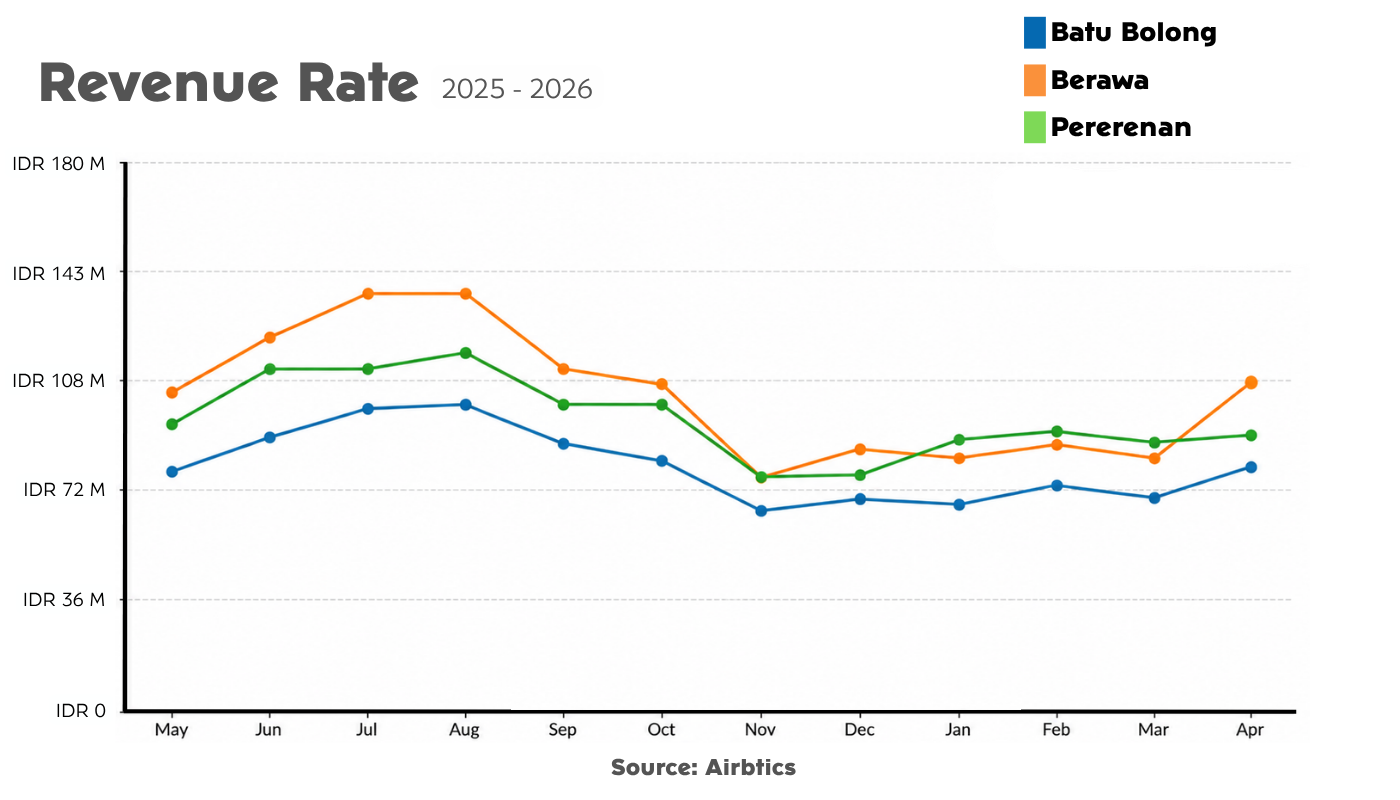
When you multiply your nightly rate by your occupancy, you get the actual cash hitting your bank account each month. This is the only metric that truly matters.
-
Berawa is the Cash Machine: If you just want maximum, aggressive cash flow when Bali is busy, Berawa is king. It pulls in a massive IDR 136 million a month during July and August. However, owners here must be disciplined, banking those massive summer profits to carry them through the sluggish 59% occupancy months in the winter.
-
Pererenan Closes the Distance: While Pererenan makes slightly less during the summer spikes, it completely catches up in the winter. In November, both Berawa and Pererenan make an identical IDR 77 million. But by January and February, Pererenan actually out-earns Berawa because its occupancy is so much more stable, bringing in IDR 88 million to IDR 91 million a month while Berawa slows down. It offers an incredibly smooth, predictable cash-flow line.
-
Batu Bolong's Deficit: Because its daily rates are capped much lower due to dense competition, Batu Bolong's revenue maxes out at IDR 100 million during its single best month of the year. It fails to break past the IDR 100M mark for 11 out of 12 months, making it the lowest grossing option of the top three.
This is where Batu Bolong leaves money on the table; it maxes out at IDR 100 million during its best month of the year and fails to cross the six-figure mark for 11 out of 12 months, making your timeline to recapture capital much longer. Meanwhile, Berawa uses its land positioning to act as an absolute cash machine, throwing off a massive IDR 136 million a month in the summer. Pererenan takes a more balanced approach, it doesn't hit Berawa’s summer highs, but its steady IDR 88M-91M rainy season floor ensures you aren't bleeding cash when the island slows down.

Our Verdict
Ultimately, there is no single "best" place to build in Canggu. Instead, your choice depends entirely on your personal investment strategy and risk tolerance:
-
Go with Berawa if you want a reliable, big-name cash machine, have the capital to handle the high land costs, and want an asset that is easy to flip later. The data shows multi-bedroom family homes provide the safest long-term revenue safety net here.
-
Go with Pererenan if you want long-term land appreciation, highly stable year-round occupancy, and fewer tenant turnovers. You are building a luxury trophy home for wealthy, long-stay travelers who value design over proximity to the clubs.
-
Go with Batu Bolong if you are building smaller spaces like highly optimized townhouses or unique one-bedroom units meant for a fast-paced, high-volume tourist crowd. The compact builds are the only asset class that consistently protects your occupancy line when the high season winds down.